
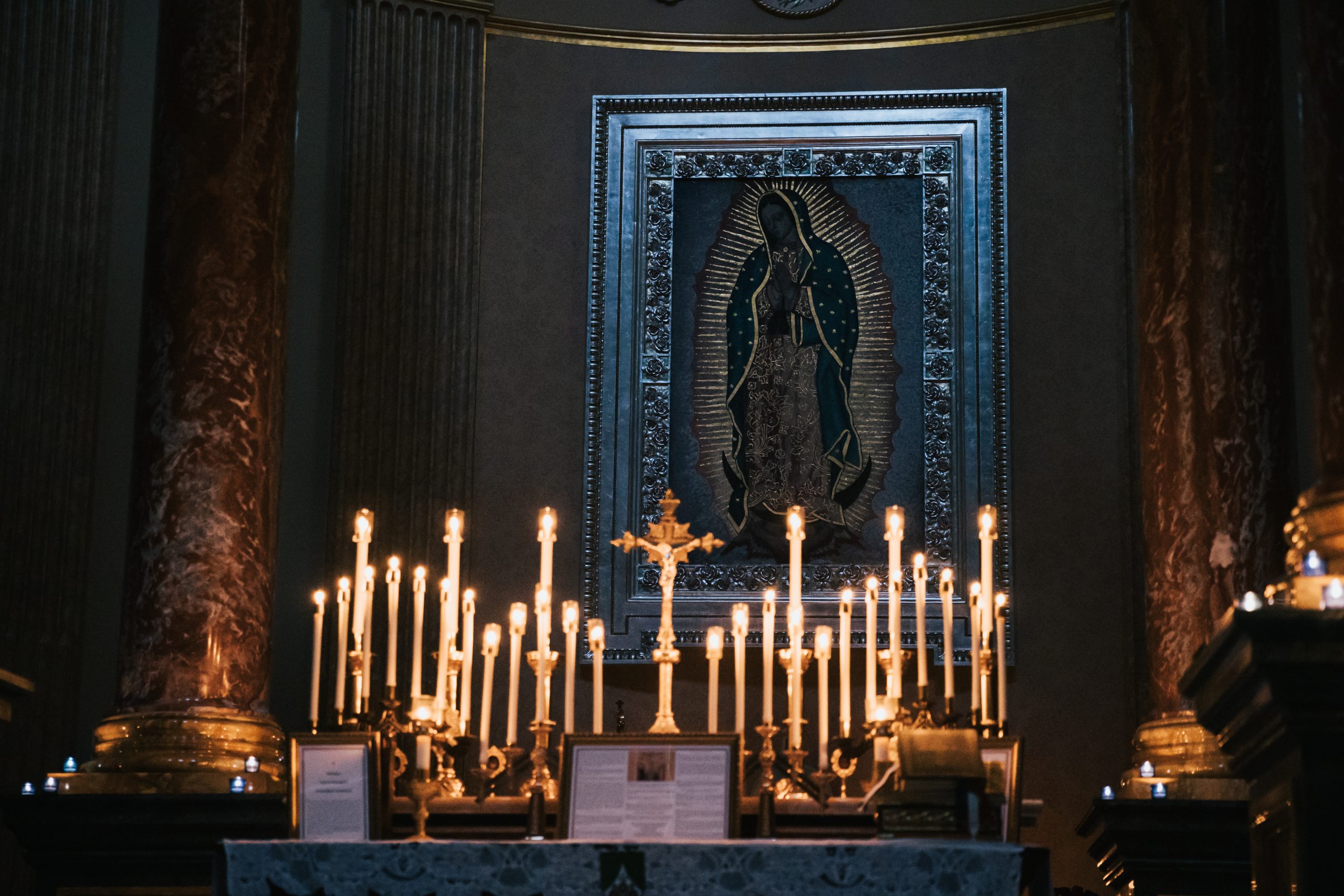
Mary’s fiat reveals the Church’s call: receive Christ, then share Him
By Father Justin J. Kizewski
What connections can we see between the Annunciation and the Visitation? What, if any, are the lessons we can draw between eucharistic reception and evangelization? Given that a Savior is born in history and is being born sacramentally in the Eucharist, in what way does this propel us into eucharistic mission? I would like to reflect with you on what Our Lady, in the mysteries of her life, can teach us about the connection between receiving the Word of God in the flesh and sharing it with others.
The Mystery of the Word That Bears Fruit
Asking questions about the Annunciation and the Visitation allows us to avail ourselves of the richness of our Catholic tradition. One principle from the Old Testament that will guide my reflections comes from the Prophet Isaiah. Isaiah proclaims, “For as the rain and the snow come down from heaven, and do not return there but water the earth, making it bring forth and sprout, giving seed to the sower and bread to the eater, so shall my word be that goes forth from my mouth; it shall not return to me empty, but it shall accomplish that which I intend, and proper in the thing for which I sent it.” (Is 55:10-12)
Isaiah compares the fruitfulness and effectiveness of the Word with how rain and snow come down and water the earth. They give seed and bread. Isaiah relates this fruitfulness to the Word, which Scripture also describes as seed—consider the parable of the sower (cf. Mt 13)—and as bread, whether in the Lord’s words during His temptation in the desert (cf. Mt 4:4), in His image of the grain of wheat that falls to the ground (cf. Jn 12:24) or most fully in the Eucharist, where the Word is consumed under the appearances of bread.
The Word is sent, and it produces fruit. This is clearly evident in Mary’s life, and it is meant also to happen in you and me.
Receiving the Word in Faith
We can first ponder the Annunciation. In pondering Mary, we should also consider the Church. There, the angel Gabriel brings her a word. Already in Gabriel’s greeting, the whole of salvation history is summed up. The angel Gabriel announces, “Hail, full of grace, the Lord is with you!” (Lk 1:28) This phrase echoes sentiments from the Old Testament, including passages from the prophets Zephaniah and Zechariah. Zephaniah professes, “Rejoice, daughter of Zion, your God is in your midst. Do not fear, Zion.” (Zep 3:14-17). Zechariah announces, “Rejoice greatly daughter of Jerusalem. Lo, your king comes to you.” (Zec 9:9) These words are fulfilled in Mary. These prophetic words find their fulfillment in Mary. The words of the prophets “in your midst” carry the literal connotation of “being born in your womb,” which applies in the strictest sense to Mary.
Before he was pope, Joseph Cardinal Ratzinger (the future Pope Benedict XVI) described Mary’s role in binding the words of the Old Testament with those of the New Testament, stating: “In the address of the angel, the underlying motif in the Lucan portrait of Mary surfaces: she is in person the true Zion, toward whom hopes have yearned throughout all the devastations of history. She is the true Israel in whom Old and New Covenant, Israel and the Church, are indivisibly one. She is the ‘people of God’ bearing fruit through God’s gracious power.”
During Advent, there is a profound reading taken from the sermons of St. Bernard of Clairvaux (1090-1135). This reading shows how the grace that fills Mary bears fruit in her yes—her fiat, “Let it be done to me according to your word.” (Lk 1:38) In the Dec. 20 Office of Readings, the Church offers us a selection from his homily “In Praise of the Virgin Mother.”
The selection opens with, “You have heard, O Virgin, that you will conceive and bear a son; you have heard that it will not be by man but by the Holy Spirit. The angel awaits an answer; it is time for him to return to God who sent him [note the similarity with the passage from Isaiah quoted above]. We too are waiting, O Lady, for your word of compassion; the sentence of condemnation weights heavily upon us… In your brief response we are to be remade in order to be recalled to life.”
Mary responds, “Behold, the handmaid of the Lord; let it be done to me according to your word.” The Word comes and is fruitful in her responding word. Mary’s yes is an acting out of the movement of the Word. He has come to her from the Father, and bears fruit in her through her yes. The fruit of Mary’s yes is nothing short of God’s becoming man in the Incarnation, leading to our salvation. God enters human history by being conceived in Mary’s womb.
Mary’s Fiat Goes Forth
The visitation is a further enactment of Mary’s yes. She responded generously and her fiat goes out from her and bears fruit. This act of “going out” to engender fruit is vividly illustrated in the Visitation. In rising with haste, Mary does exactly what receiving the Word compels. Author Settimio Manelli refers to Mary’s movement here as a “protopentecost,” a kind of first Pentecost. Mary’s move to proclaim the Word ignites a sharing of the spirit in Elizabeth, John the Baptist, Zechariah and Anna.
Mary embodies the movements of the first Ark of the Covenant. Many authors point out that Mary’s journey to visit her cousin mirrors the route taken by the Ark of the Covenant in the Second Book of Samuel. (2 Sm 6:2-16) The original ark contained the Word inscribed on stone tablets, the bread from heaven and Aaron’s priestly staff. The New Ark of the Covenant, as the Book of Revelation testifies, is a woman who carries in her womb the Word made flesh, the true Bread from Heaven and our High Priest. Like her predecessor, she follows the same path and arrives at the same location where the Ark once stayed. She remains there for the same amount of time, and her presence elicits the same responses in the Spirit—words of ecstatic joy.
What can we learn from Mary about our own reception of the Word made flesh in the Eucharist? It is common to compare Mary’s time with the Lord in her womb with our brief time after holy Communion. Mary’s pregnancy becomes an icon of our own act of thanksgiving after receiving the Lord. St. John Paul II noted, “At the Annunciation, Mary conceived the Son of God in the physical reality of His body and blood, thus anticipating within herself what to some degree happens sacramentally in every believer who receives, under the signs of bread and wine, the Lord’s body and blood.” The author Lawrence Feingold points out, “Through holy Communion the faithful receive in their bodies the same humanity of the Word that Mary received in her womb.”
Sent Forth as Living Tabernacles
We learn in the Visitation that the living tabernacle is meant to go mobile. We are meant to take the Lord—alive in us—to the places that need Him. We are meant to spread the paschal joy, visible at Pentecost, to those who are awaiting Him and are in need of His Good News.
We joyfully await the coming of the Word during Advent, and we confidently expect His arrival when at Mass. When we receive Him in holy Communion, we are filled with the Word, which must then be expressed to be fruitful. The Holy Spirit propels us to carry the Word forth to others so that it bears fruit in them. We proclaim to them, in a very literal and Marian way, “God is with us.” The author Lawrence Feingold points out, “Through holy Communion the faithful receive in their bodies the same humanity
of the Word that Mary received
in her womb.”