
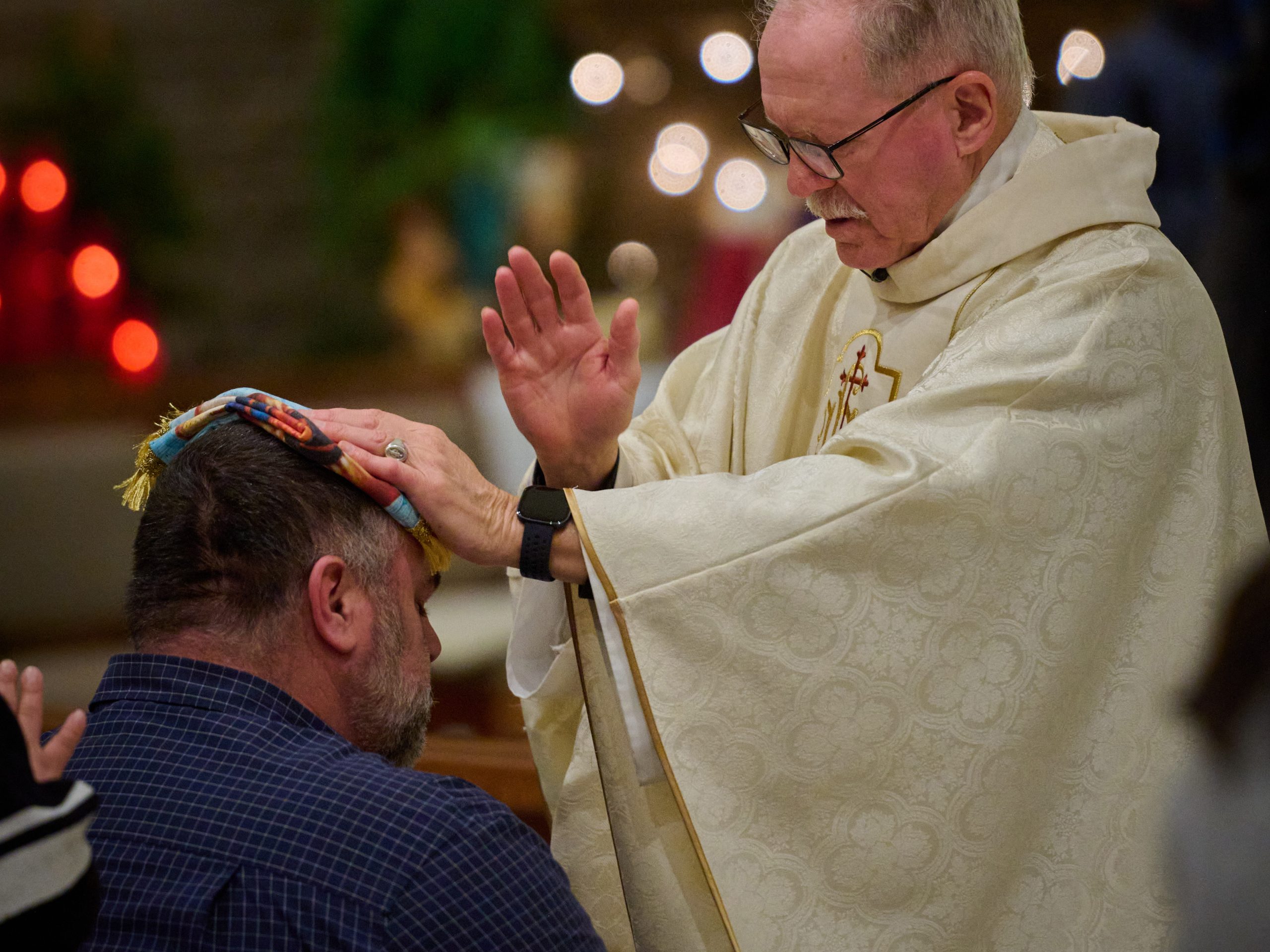
The Diocese of La Crosse’s apostolic tradition of healing
“In my deepest wound, I saw your glory and it dazzled me.”
“God, your Father, wants you to be whole!” These words, spoken by Father Michael Klos of Sacred Heart of Jesus and St. Patrick parish in Eau Claire, are more than a comforting sentiment; they are a profound invitation to reclaim a central part of our Catholic inheritance. Throughout the Gospels, we see Jesus moving through the crowds, not just as a teacher of truths, but as a healer of persons. Today, that same healing mission continues to pulse through the life of the Church, connecting the historical miracles of the New Testament with the people in the pews of our own parishes.
Pope Francis famously called the Church a “field hospital,” a place where theology meets human suffering. The healing ministry in the diocese of La Crosse doesn’t seek the sensational, it is simply focused on the quiet, orderly and powerful restoration of the human person in this field hospital. This ministry strengthens the diocese because, as Father Klos explains, “We are the diocese, we are the living stones of the Church. Thus, anything which strengthens us individually as members of the Body of Christ, strengthens the whole body.”
Whether a wound is physical, emotional or spiritual, the Church’s mandate remains the same: to bring the transformative touch of Jesus Christ to every heart. Across the Diocese of La Crosse, at St. Matthew Parish in Wausau, Sacred Heart/St. Mary’s Parish in Cashton/Viroqua, Immaculate Conception Parish in Eau Claire, in La Crosse and the growing center in Marshfield, this ministry holds a specific and disciplined shape. Indeed, the ministry is undertaken with the explicit permission of the diocesan bishop.
“Every Mass is a Healing Mass”
The primary hurdle in discussing healing ministry is the fear that it exists outside the normal life of the Church. Cautious Catholics often view healing services as a Protestant import or a fringe charismatic novelty. Father Klos sees this hesitation as a byproduct of our times. “I think this ministry resonates strongly now because people, especially young people, are ready to shed the cynicism of the world we have inherited from a time of ‘enlightenment’ fueled skepticism,” he explains.
Father Klos notes that the greatest obstacle isn’t just cynicism, but a specific deception: “The greatest wound keeping us from healing is the lie that God doesn’t—or never did—do miracles.”
The reply to this skepticism is squarely sacramental. “Holy Mass is the service of healing,” Father Klos explains. “Every Mass is a healing Mass.” This truth is the light for skeptics to follow. By anchoring the ministry in the Liturgy, the Church ensures healing is never rooted in anything but Christ and that the Eucharist remains the source and summit of all restoration.
Indeed, echoing Father Klos’ sentiment, when we receive the Body of Christ, we are receiving the Healer Himself. Every time we say, “Lord, I am not worthy … but only say the word and my soul shall be healed,” we are participating in a healing service.
However, if the Mass is the “medicine,” healing prayer is the “triage” that helps a soul receive that medicine more effectively. This encounter often begins in the sacrament of reconciliation. Father Klos describes confession as an examination of the heart that opens us up to the Spirit, helping us recognize “where in our hearts we are holding on to past wounds, including those wounds which keep us from physical healing.”
Father Klos also points out a crucial distinction that many miss: the sacrament of the anointing of the sick has specific canonical limits. It is reserved for those facing serious physical illness, surgery or the frailty of old age. Yet, humans aren’t just bodies; souls and spirits need care as well. Many Catholics carry silent wounds such as addictions, deep-seated unforgiveness and emotional trauma. Despite the grievous effects imparted, none of these wounds meet the criteria for sacramental anointing.
Some people may feel too spiritually paralyzed by shame to enter the confessional or attend Mass. Healing prayer “picks up in those areas not covered by the sacraments,” Father Klos notes. It acts as a bridge.
The Golden Mean: Order and Peace
In 2000, Cardinal Joseph Ratzinger (the future Pope Benedict XVI) issued a landmark document through the Congregation for the Doctrine of the Faith. This document, the “Instruction on Prayers for Healing,” is foundational in any healing ministry as it outlines a golden mean between cold rationalism and chaotic emotionalism. Crucially, “Instruction on Prayers for Healing” establishes guidelines that define and protect against the over-indulgence and sensationalism that can sometimes plague the perception of healing movements.
Then-Cardinal Ratzinger balanced the profound human desire for healing with a concern that healing services, unconstrained, could become theatrical or hysterical. He insisted that these services must be characterized by sobriety, peace and, in all things, a sacramental root.
To that point, Natalie Elskamp, one of the lay leaders in the diocesan healing ministry, notes that healing ministry participants represent a cross-section of the faithful, showing that this work of the Holy Spirit moves beyond simple labels of “charismatic” or “traditional.” This is the vision: a ministry that is vibrant and supernatural, yet strictly under the authority of the local Bishop and rooted in the Church’s ancient traditions.
A 2,000-Year Tradition: From the Apostles to Today
To understand this tradition, one must first define what “being healed” is. Father Bob Thorn notes that the Church’s reach is broad: “Healing can refer to actual physical healing: a person who was blind from birth suddenly able to see; to psychological healing: depression and anxiety, PTSD; or it can refer to addictive healing.”
With this definition in-hand, an understanding of our ancient, and unbroken, traditions helps dispel any fog of misunderstanding that healing ministries are a recent focus. Very clearly, healing in the Church is not a new ministry so much as it is a revival of a 2,000-year-old truth.
The Apostolic Mandate: In the first century, Jesus’ ministry was defined by the union of preaching the Kingdom and healing the sick. This mandate was passed directly to the Apostles. The Epistle of James provides the earliest blueprint: “Is anyone among you sick? Let them call the elders of the church to pray over them and anoint them with oil in the name of the Lord.” (Jas 5:14–15)
The Institutional Shift: By the fourth century, the Church faced various charismatic heresies, such as Montanism. The Church “institutionalized” the healing ministry, concentrating it within the formal sacraments and the quiet intercession of the monasteries. For centuries, the extraordinary gifts of the Holy Spirit were seen primarily in the lives of the great saints.
The Reawakening of the Spirit: This institutional caution began to shift at the dawn of the 20th century. Inspired by the persistent letters of St. Elena Guerra, canonized in October 2024, who urged the Church to return to the “Upper Room,” Pope Leo XIII dedicated the new century to the Holy Spirit on Jan. 1, 1901. This “reawakening” bore fruit decades later during the Catholic Charismatic Renewal (CCR).
The Modern Renewal: The CCR began in 1967 following Vatican II. This movement saw the re-emergence of the charism of healing among the lay faithful. Much of the modern divisiveness stems from this point in time. Then-Cardinal Ratzinger’s Instruction of 2000 aligned the renewal with the Church’s liturgical traditions.
The “Audacious Fact” of the Wounded Healer
Perhaps the most striking aspect of the ministry in La Crosse is the shift away from “personality-driven” healing. Father Klos points to a truth: “Healing ministry was never intended to be relegated to a certain few, powerful ‘saints’; God empowers all of the baptized to be conduits of his healing love and mercy.” He calls this an “audacious fact” that every Christian should embrace as part of their identity.
This leads to the concept of the “wounded healer,” a term Father Bob Thorn uses to describe the heartbeat of the local teams. “People who have been delivered and healed of hurts and abuses, past traumas and sinful actions, are the wounded healers who can readily bring Jesus’ message of love and healing to others,” says Father Thorn.
This framework moves the ministry from a “top-down” miracle service to “peer-to-peer.” Father Thorn observes that once a person is healed, the change is visceral: “After being prayed with/over … the person no longer has the desire or tendency to indulge in the addiction.” This means our past wounds, once healed, actually become our greatest credentials. A man who has found healing from a decades-long addiction to pornography, for example, possesses a unique standing to pray for a young man struggling with the same burden.
The “Triage” of the Field Hospital
The intersection of a healing ministry with professional mental health is a place of sharp focus—both as a Church and through the eyes of people suspicious of the ministry. Natalie frames the approach as discerning rather than confining. Prayer teams are not only trained to listen and abide in the Holy Spirit to help bring those they pray with to Christ’s healing mercy, they are also trained in a form of “spiritual triage.”
As in all things authentically rooted in the Faith, the healing ministry does not compete with science; it completes the picture. “We aren’t looking for a demon behind every bush,” Natalie explains. The ministry team is trained to listen for the difference between a spiritual wound, a psychological trauma and a biological condition and will encourage connection with professional resources when appropriate.
When the triage identifies a spiritual wound, the focus shifts toward reconciliation. Father Bob Thorn notes that because sickness and suffering are consequences of the Fall, healing must begin with getting right with God and others. “Forgive us our trespasses as we forgive those who trespass against us” is the starting point.
As Father Thorn explains, “I’m not saying what you did was right. By forgiving you, I’m just removing the burden, the onus of unforgiveness from myself so I can move on.”
The Roadmap to Interior Freedom
But “moving on” requires more than just a clean slate. Father Thorn warns that Jesus often pointed out the need to refrain from sin after being healed, as was seen with the woman caught in adultery and the man healed at the pool of Bethesda. The goal is to ensure the “house” of the soul does not remain empty.
Quoting the Gospel of Matthew, Father Thorn warns that a house “swept clean” but left vacant is an invitation for even worse trouble. This is why the diocese utilizes such disciplined and systematic approaches. The “roadmap” isn’t just about removing a wound; it’s about filling that space with the life of Christ so that the person can truly live in freedom.
This is not a matter of technique, but of encounter. As Father Sedlacek observes, “People find healing from an encounter with the love of the Healer, Jesus Christ.”
Often, this encounter is blocked by specific spiritual obstacles. In the process of a “healing of memories,” forgiveness must be understood. It is not an act of excusing the harm, but a deliberate release of the “debt” owed by the offender. By canceling this debt in the name of Jesus, the individual removes the barrier that prevents them from receiving God’s love, finally lifting a trauma carried for decades.
The result is not just emotional relief, but a restoration of the ability to pray and live in peace. As Father Thorn observes, “The most powerful healing experiences are when a person who has been burdened with hate, unforgiveness, anger and rage is suddenly laughing and embracing others with love.”
A Father Waiting for You
As Father Klos concludes, the message for every reader is simple yet profound: “God, your Father, wants you to be whole! He is a father who loves you and is waiting only for you to turn to Him.”
Whether you are a skeptic looking for the muscle of Church doctrine, a traditionalist seeking “right order” or a wounded soul seeking an encounter with love, the field hospital is open. The triage is ready. The Healer is present.”
RESOURCES FOR RESTORATION
Local Opportunities
- Healing Masses and Services: The primary “front door” for the ministry. These services are held regularly in Cashton, Wausau and Eau Claire, and typically include adoration, confession and individual prayer. Consult local parish bulletins for scheduled times.
- Healing the Whole Person Workshops: Parishes around the diocese offer the eight week “Healing the Whole Person” series. The sessions guide participants to enter into their own story, face wounds and brokenness and receive healing, freedom and wholeness in Christ. For local inquiries, contact Ms. Natalie Elskamp at: laxloveheals@gmail.com.
Personal Study & Formation
- Instruction on Prayers for Healing (2000): The official Vatican document signed by Cardinal Joseph Ratzinger. It provides the “Right Order” and disciplinary norms for how the Church conducts healing services.
- Unbound by Neal Lozano: The foundational book explaining the “Five Keys” to deliverance and spiritual freedom.
- Be Healed by Dr. Bob Schuchts: A guide to encounter Jesus, face brokenness, and receive deep healing in Christ (jpiihealingcenter.org)
- “Healing the Whole Person”: Offered by the John Paul II Healing Center. Can be completed online or in-person. virtual.jpiihealingcenter.org/course/hwp
- Restore the Glory Podcast: “A podcast about the healing and restoration of our God-given glory,” hosted by Dr. Bob Schuchts, founder of the John Paul II Healing Center and Jake Khym.
Note: Healing prayer is a complement to, not a replacement for, professional medical and mental health care.