

Father Joseph Richards puts his woodworking skills to use restoring an old crucifix
Story by Dan Rislove
A Time for Renewal
“Mid-century modern” was how Father Joseph Richards described the Annunciation of the Blessed Virgin Mary Church in Viroqua. Built in 1959, the church underwent its first remodeling in the 1980s, during which a decision was made to replace the statue of Christ on the cross behind the altar with a more contemporary design. The new statue, beautiful in its own way, depicted the risen Christ next to the cross, with one hand pointing to heaven and the other displaying the wounds of the crucifixion. For more than 40 years, the statue of the risen Christ had become a comforting fixture in the church. But styles and tastes change, sometimes coming full circle. The parish took another look at the old crucifix, which had been in storage for four decades and considered returning it to the sanctuary.

In 2022, Bishop William Patrick Callahan appointed Father Richards as pastor. At the same time, the Inspired by the Spirit Campaign was in full swing. As a new pastor, taking on a renovation project wasn’t his first choice, but Father Richards met with the parish council and together they forged ahead. The original crucifix, which was somewhat stylized and angular in design, fit right into its mid-century modern setting, which they were attempting to restore.
Unfortunately, time had not been kind to the original crucifix. Although it had been stored in a semi-trailer that protected it from the elements, issues with humidity control led to the growth of mildew and cracking in the wood. At some point, mice entered the trailer and damaged the crucifix. The original cross on which the corpus hung was in such a dilapidated state that a new cross needed to be constructed from scratch. Father Richards assessed the damage and decided to take on the project of restoring the crucifix himself.
Woodworking as a Charism
Father Richards first developed an interest in woodworking as a boy in California. He watched his father, a general contractor, complete various building projects, and when he arrived at Mundelein Seminary in Illinois, he started spending a lot of time in the campus woodshop. Between classes, he built furniture, boxes and other items. Working with his hands provided a welcome break from the intellectual demands of studying to become a priest. Once he was ordained, Father Richards started investing in his own workshop. By the time renovations commenced, he had enough tools
and experience to take on the project of restoring the old crucifix.
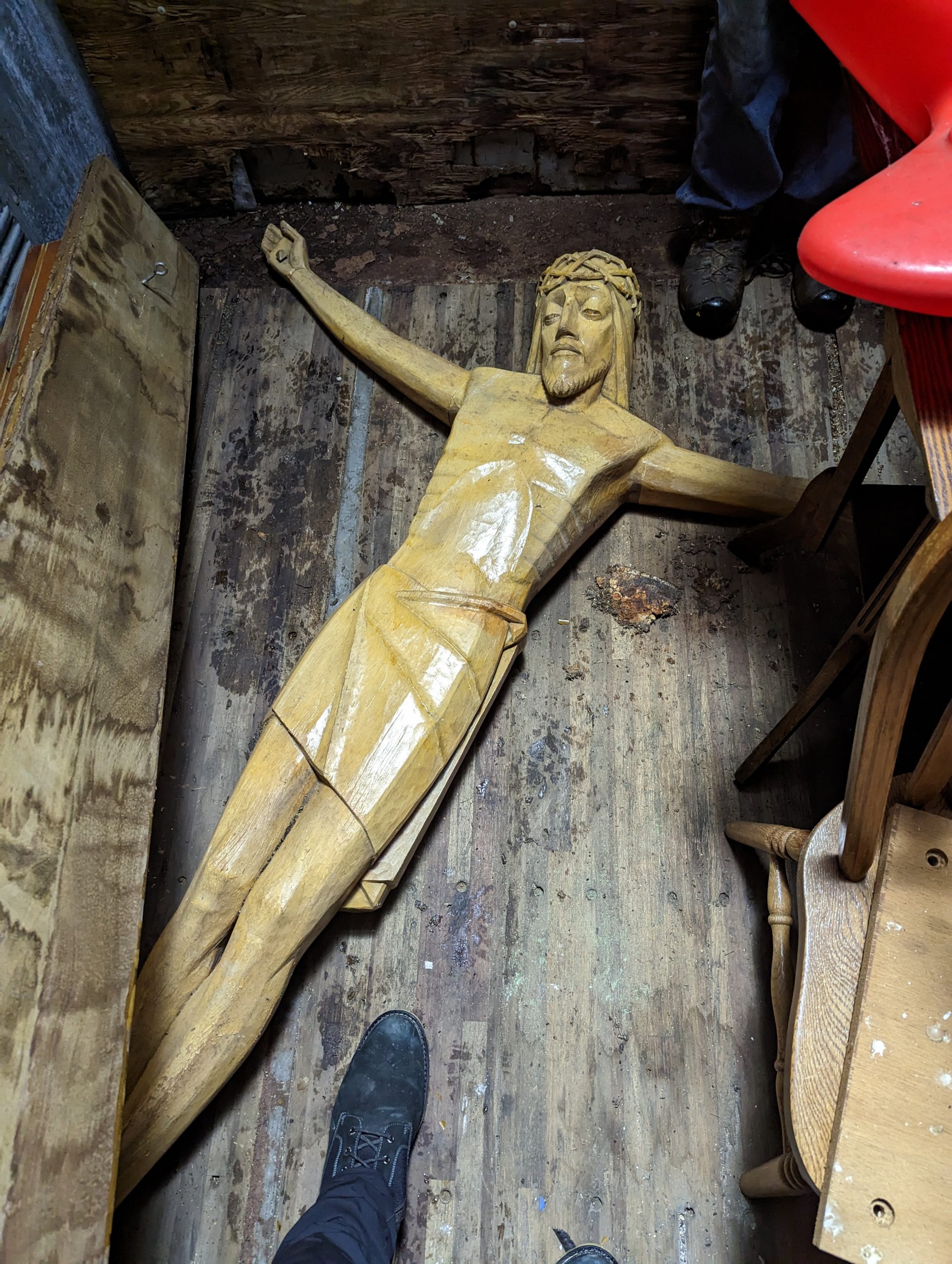
He started by removing the corpus of Jesus from the cross. The original cross was recycled, and a new one was constructed from scratch, which took about 15 hours. Restoring the corpus was a much more complex project that required well over 100 hours
of dedicated work.
First, Father Richards had to strip the old finish without damaging the underlying basswood. Due to mildew infiltration, he used
a vinegar solution to eliminate the mildew, followed by multiple cycles of sanding. Cracks needed to be filled, the arms had to be removed and then reattached after repairs.
Jesus’ missing fingers needed to be sculpted from a new block of wood and reattached to the original hand. However, that wasn’t the only sculptural work required. The style of the original corpus had many sharp angles and a modernist, stylized anatomy. Father Richards took it upon himself to round out and soften Jesus’ features, making Him appear more human and relatable. He also dedicated a significant amount of time to enhancing textural details, such as Jesus’ hair and facial features.
I asked Father Richards what went through his mind as he sculpted the crucified Jesus. He said the realization that he was shaping Christ came to him in waves. Initially, he viewed the body as a whole, but as he focused more closely, he spent a considerable amount of time considering each part in detail—the face, the hands and the feet. He was particularly surprised by how sculpting Jesus’ knees affected him. “I had never focused on Jesus’ knees before, and now here I am, carving out Jesus’ meniscus,” he remarked.
This was a striking reminder of Jesus’ humanity.
Revealing the Crucified Lord
By Palm Sunday 2025, the corpus had been refinished and remounted on a newly constructed cross. The rest of the renovation was also progressing nicely. The altar was raised, reinforced and rotated 180 degrees so that the Chi-Rho inscription—an ancient Christian symbol made from the first two Greek letters of “Christ” (X and P)—was visible to the congregation again. The vinyl and carpet were replaced with stone, and the back wall was repaneled and painted. While some furnishings and paintings still needed to be installed, the sanctuary was sufficiently complete to be unveiled to the eager parishioners. On that Palm Sunday, the construction curtain hiding the renovations was finally removed, and they celebrated Mass in the newly renovated sanctuary for the first time.
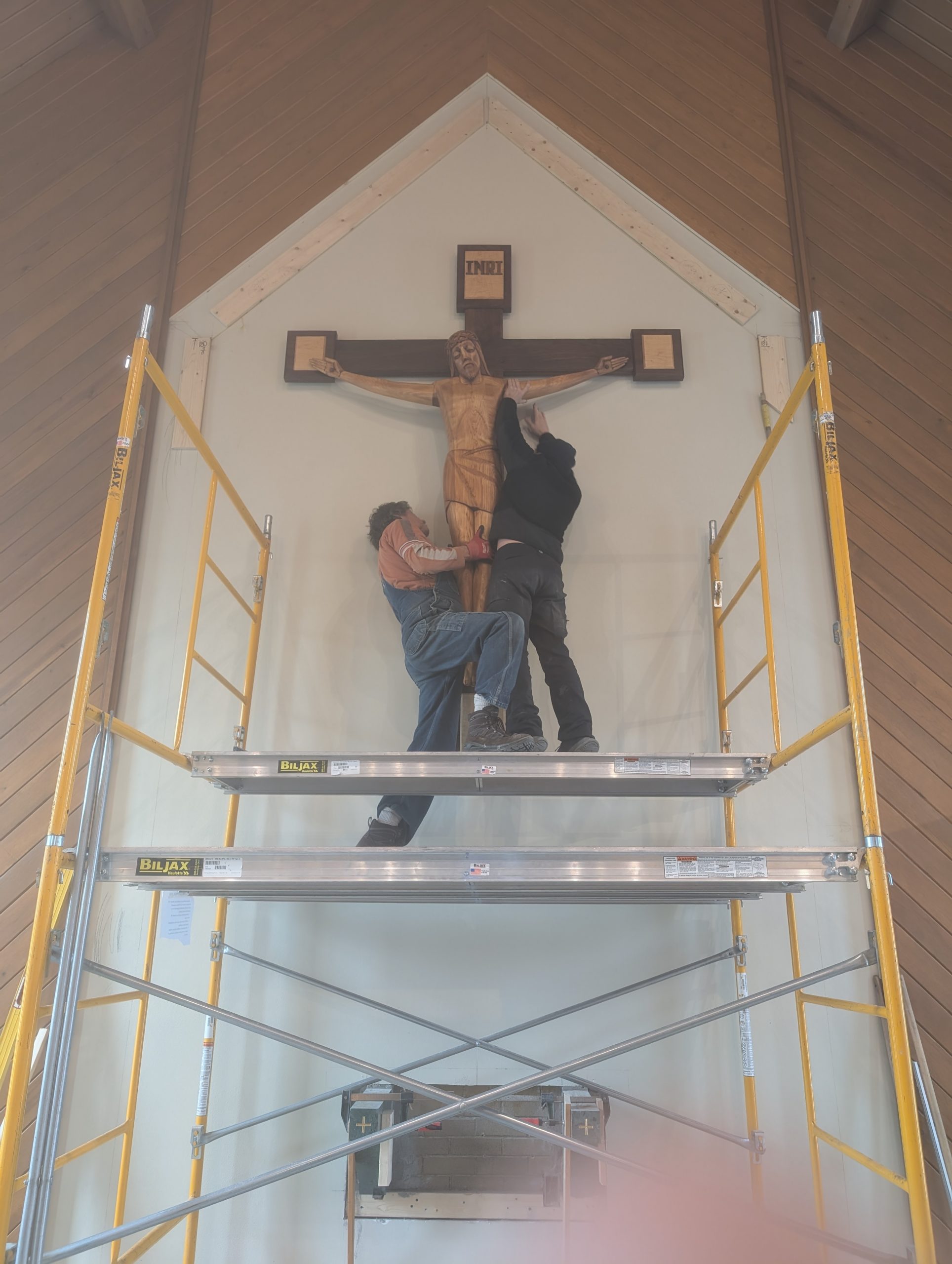
Father Richards described the reaction that day as one of relief. Most parishioners knew change was coming, and for some, this created a sense of anxiety. The church is like a second home to many of the parishioners, as Father Richards explains. When you remodel your own home, you have direct control over the process. However, a church renovation is a community project, which can lead to feelings of anxiety because it involves changes beyond one’s personal control. Regardless of their opinions on the changes, parishioners felt relieved to see the new sanctuary and to understand what had been happening behind the scenes. Ultimately, the parishioners had a lot of goodwill toward the project and were generally pleased with the outcome.
Fortunately for those who are nostalgic for the old sanctuary, the statue of the risen Christ, first installed in the 1980s, now hangs in a place of honor in the church’s gathering space. That statue is an image of redemptive suffering, which Father Richards finds important in Catholic theology, and he’s glad that they were able to find it a new home.
I asked him if he had received any compliments on his restoration of the crucifix. He explained that most parishioners had never seen the crucifix before its restoration, so they were unaware of the extent of his work. “That’s my preference,” he said. “I like it when people don’t see the before and after and don’t know the work that went into it. As the workman behind it, I’m okay with that.” In fact, he considers the general lack of criticism to be a ringing endorsement. He said he enjoys walking into a space where he has done woodwork and, for a moment, forgetting that he worked on it. He appreciates the experience of suddenly recalling why that altar, crucifix or piece of furniture looks so familiar.
Father Richards continues to spend his free time in his workshop helping with various projects. Currently, he is wrapping up some final statuary for the renovation and moving his attention on to Christmas gifts. He seems to find joy in this work. “There is something beautiful about bringing new life to something old and weathered,” he says, “whether it’s a house or a cross.”