
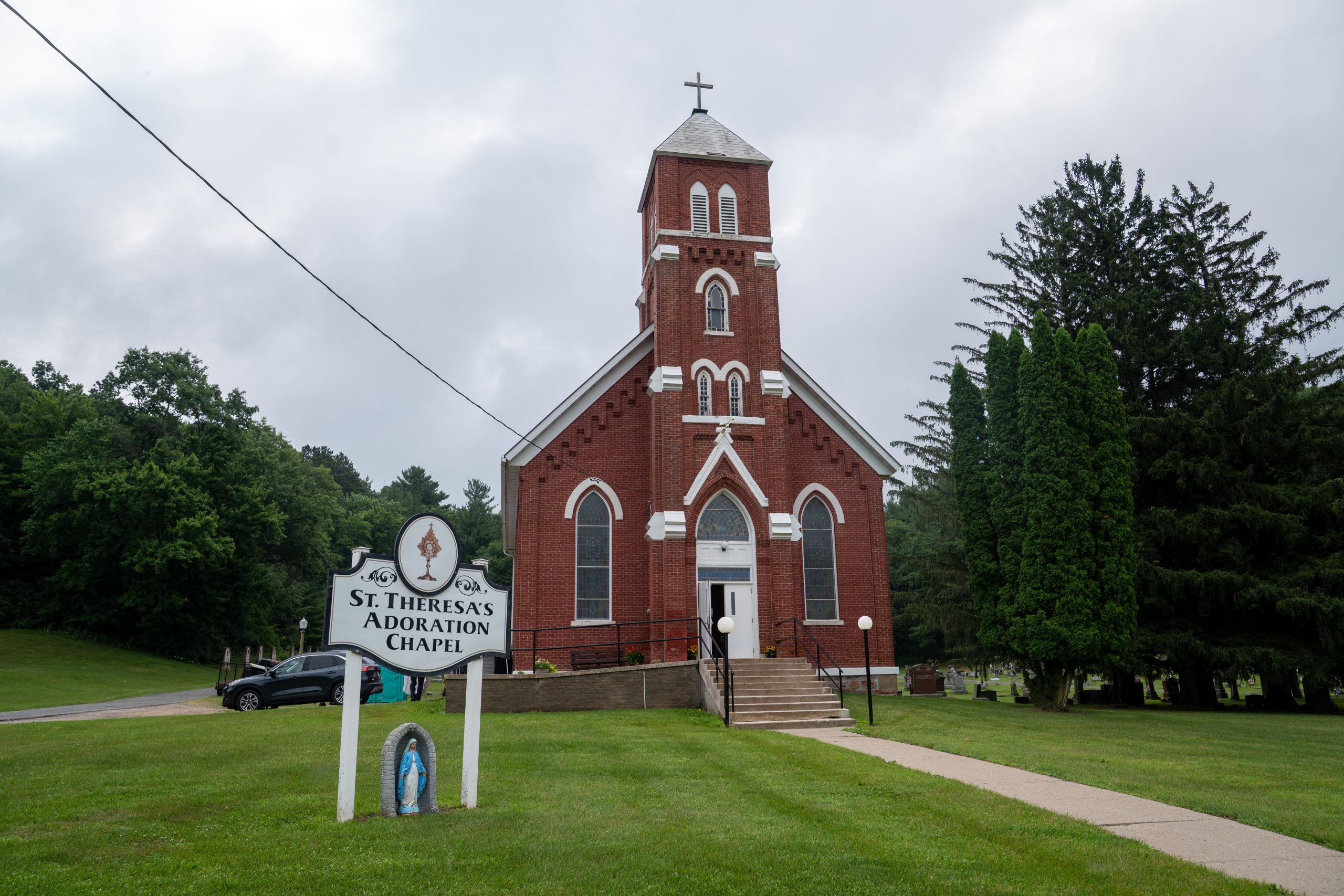
From pioneer settlers to a thriving place of eucharistic devotion, St. Theresa’s Adoration Chapel continues to shine as a beacon of prayer.
Story by Marcy Stenstrom
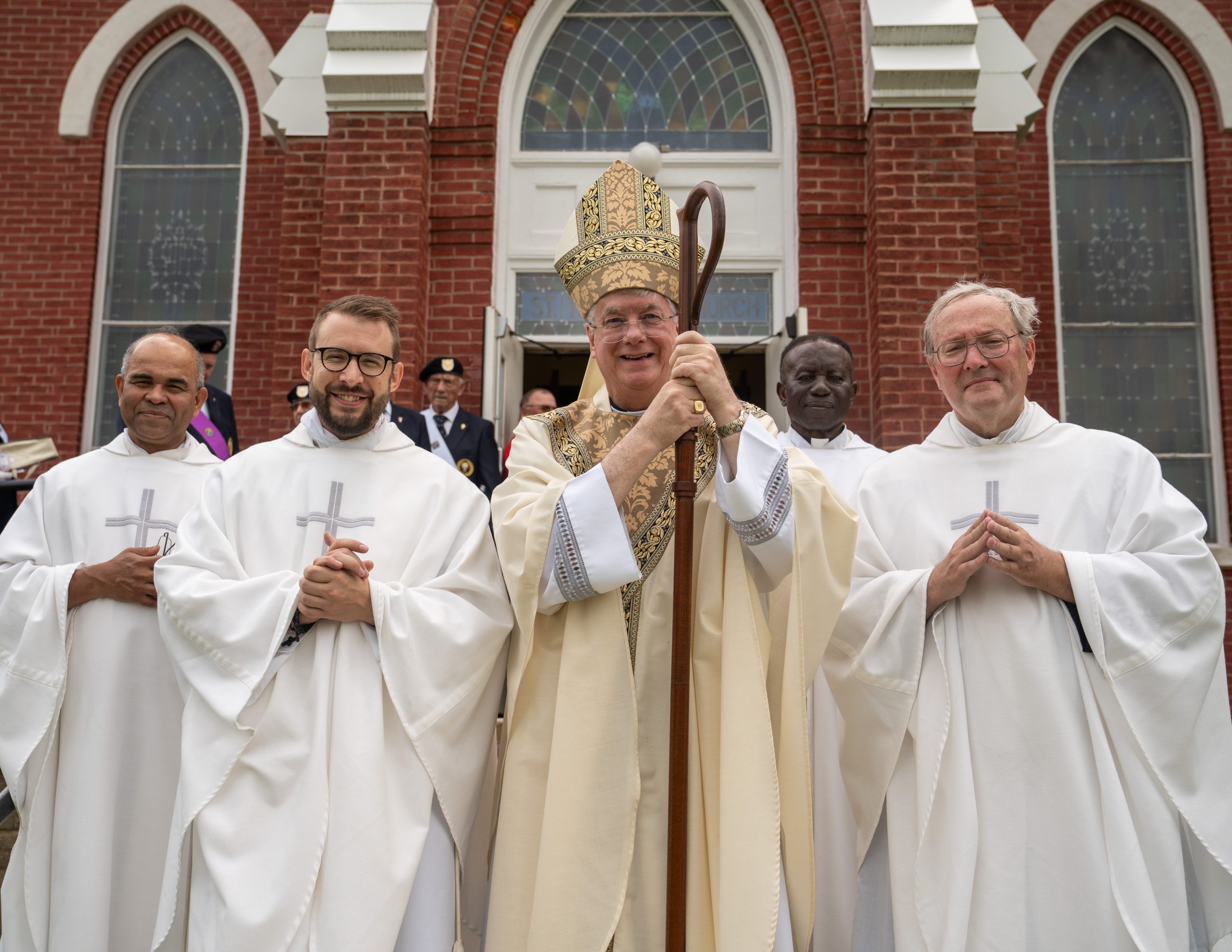
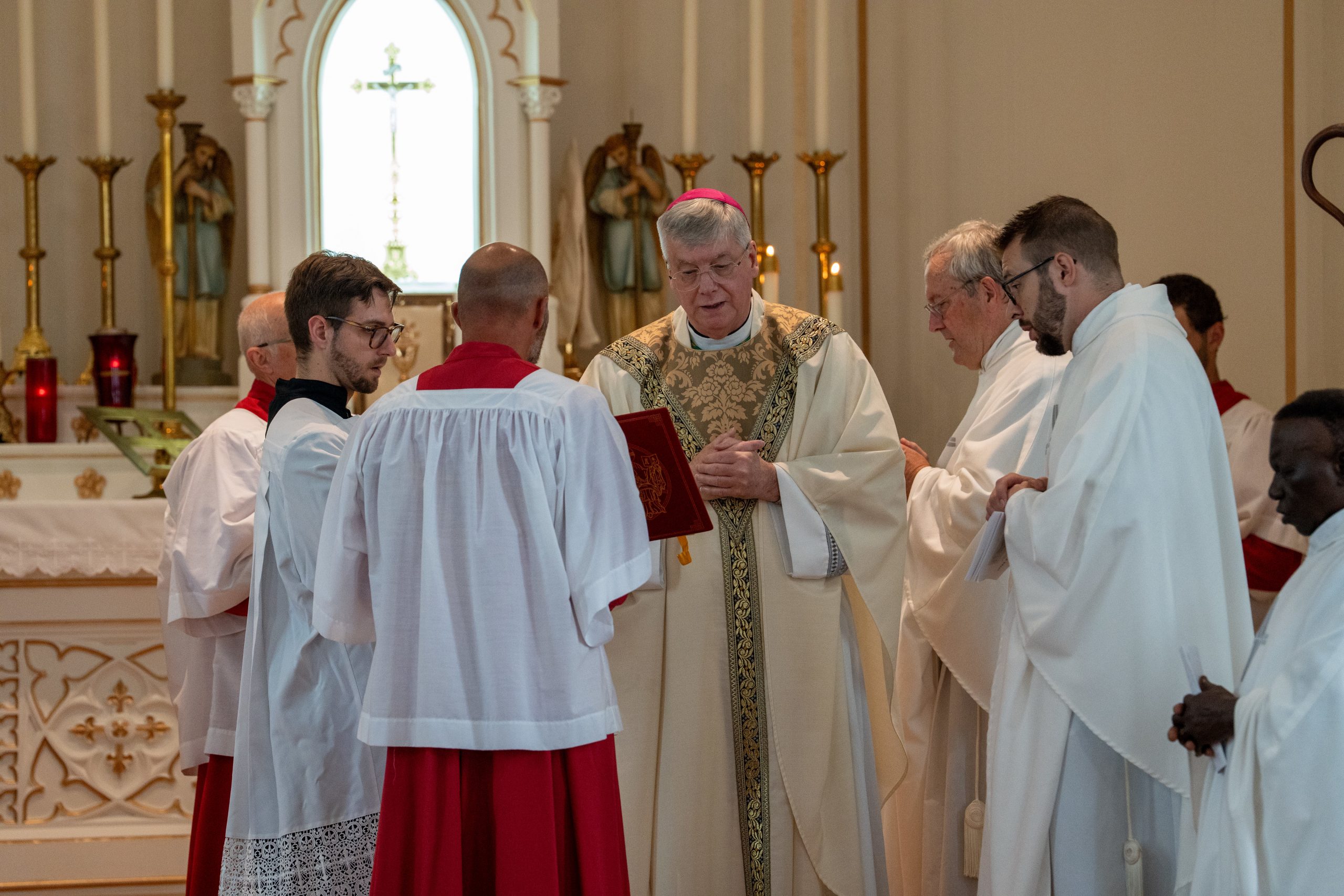
Union Center, a small rural town in Juneau County, has a population of about 200 residents. It lies on the eastern outskirts of the Diocese of La Crosse. There you’ll find a simple, yet historical, Catholic Church that reflects the culture of the early Irish and German settlers. Like many rural township churches, this one has a rich history and an inspiring story shaped by necessity and faithful determination. The little church is a snapshot of an era worth celebrating and The Most Reverend Gerard W. Battersby, bishop of the Diocese of La Crosse, was delighted to commemorate it with Mass on July 12.
Humble Beginnings
In 1854, just six years after Wisconsin was ratified as a state, the first Irish and German immigrants settled in what is now known as Union Center. When the American Civil War began in 1861, many residents enlisted in the Union forces and were involved in battles, with some making the ultimate sacrifice. Due to the need for a burial place for the deceased, two local families donated four acres of land to create a cemetery.
After the cemetery was established in 1862, the local community desired to have a shared place of worship. A simple framed church building was constructed off-site and transported by a team of oxen to its current location, thanks to the generosity of several individuals. Before this church was built, the first priests in the area celebrated Mass in people’s homes and depended on the locals’ hospitality and assistance to travel, lodge and offer sacraments. With the new church, Catholics from the surrounding areas could now gather in a centralized location for worship.
A House for the Faithful
At that time, the entire state of Wisconsin fell within the Diocese of Milwaukee. However, in 1866, the Second Plenary Council, a meeting of the United States bishops, decided to establish the Diocese of La Crosse and the Diocese of Green Bay to better serve the growing Catholic population. The small parish in Union Center became known as St. Patrick’s, reflecting its Irish heritage and fell within the territory of the newly established Diocese of La Crosse.
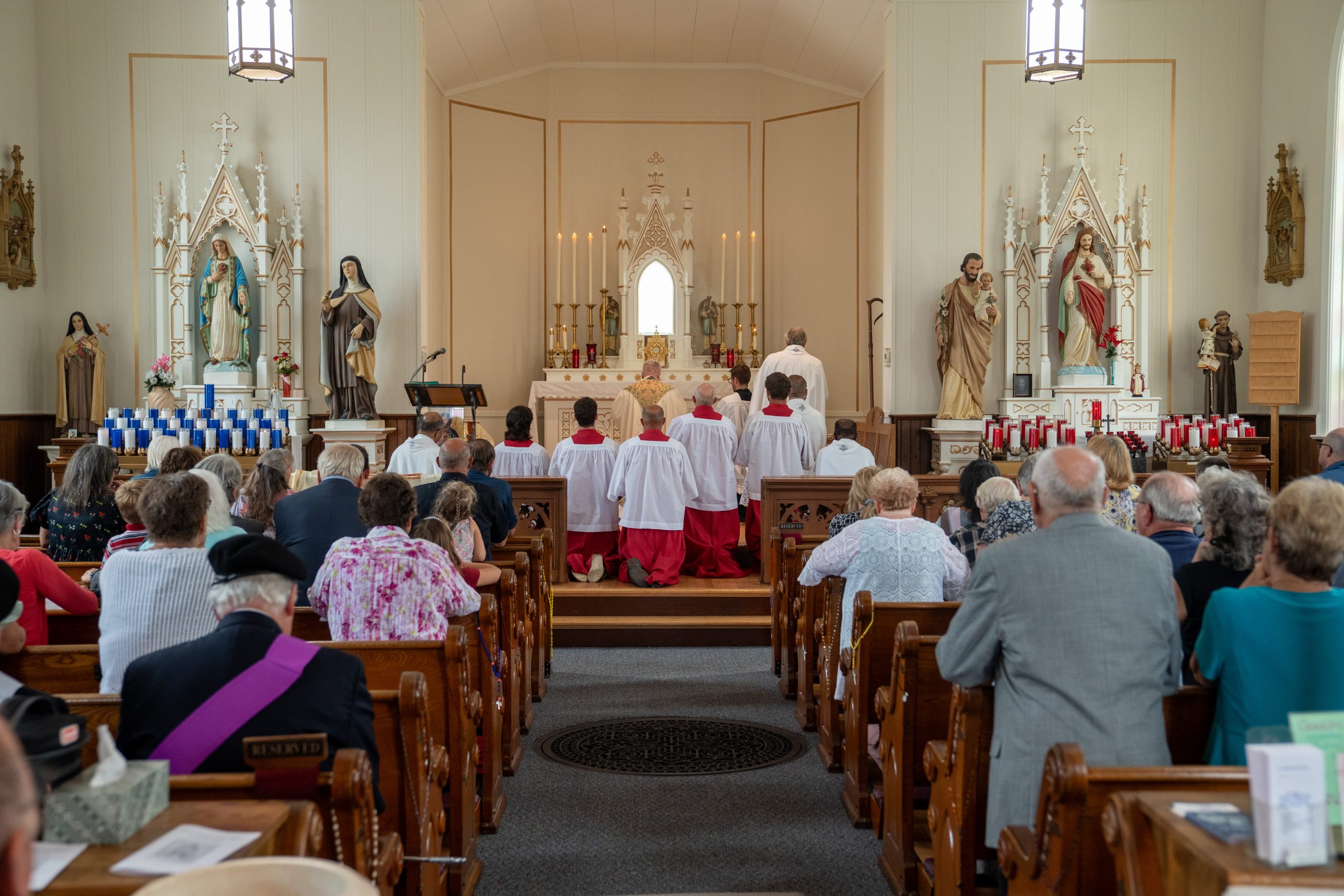
In 1878, the church’s name was changed to St. Theresa in honor of a local woman who generously funded many improvements to the building and offered hospitality to both traveling and residential priests. By 1892, the first resident pastor and parishioners had built a foundation under the church, influenced by Gothic architecture and added brick around the original wooden frame. Most of these improvements were completed by 1893, just before an organ and a Gothic-style altar were installed.
The church’s towering spire was added in 1907, along with an 800-pound bell flanked by two smaller bells donated by parishioners in 1908. Five years later, St. Theresa Parish celebrated its golden jubilee. Much of the church’s interior, including the 14 wooden pews and kneelers, the Gothic altar and architecture, as well as the ornate statues and hand-carved pillars and scrollwork, remains unchanged from 100 years ago.
A New Life of Prayer and Adoration
In 1996, after many years of prosperity and cherished memories, it was determined that St. Theresa Parish could no longer sustain itself. Several factors contributed to this decision, including a declining number of parishioners and priests, as well as an overall decrease in the area’s population. Additionally, the proximity of neighboring parishes made it more economical and feasible for modern parishioners to travel to a single parish rather than having one priest serve multiple locations.
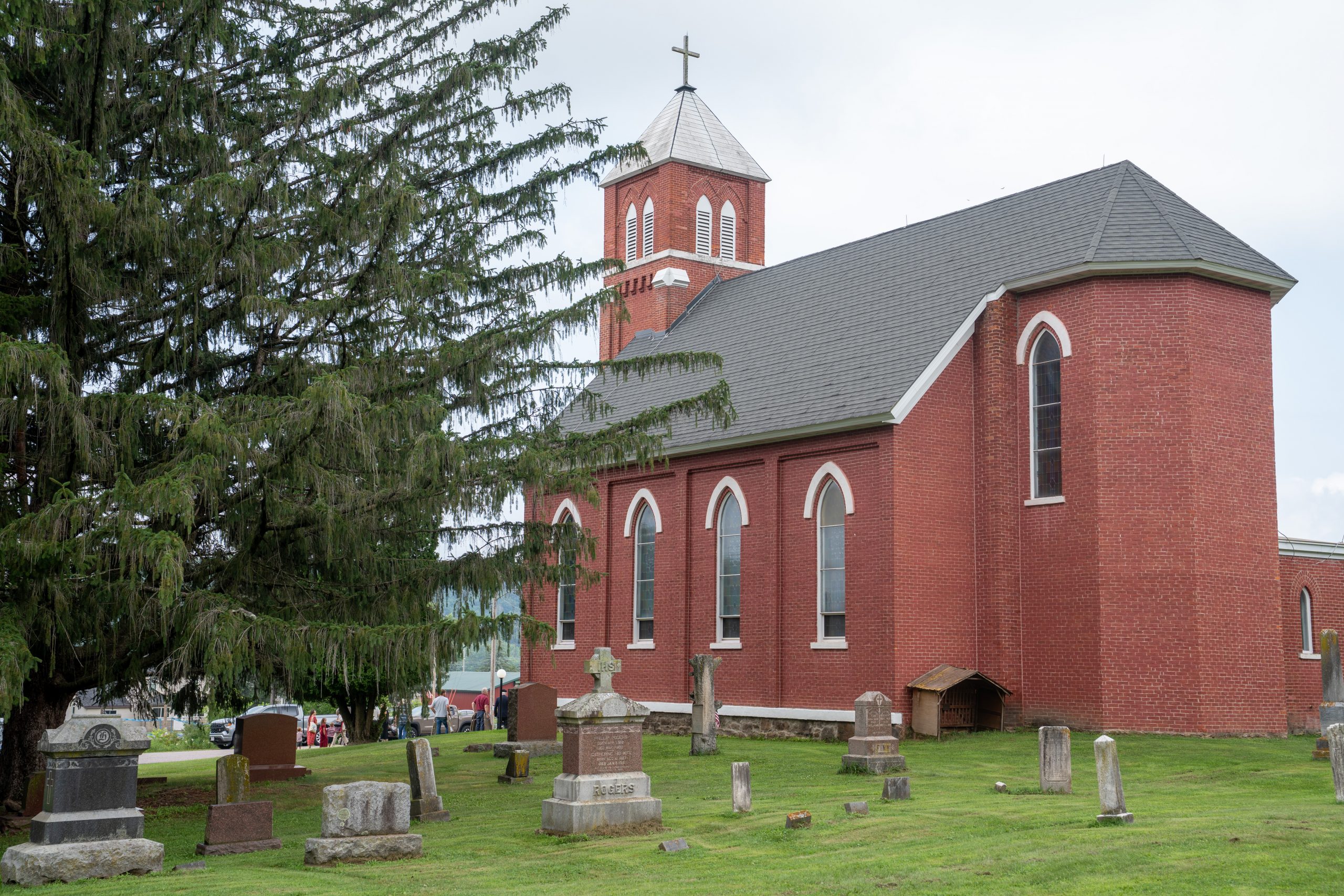
After much discussion, then-Bishop Raymond Burke decided to suppress the parish. However, the church building was to be preserved as an oratory or chapel. Responsibility for its care and maintenance was entrusted to the St. Theresa Cemetery Association, under the pastoral supervision of the neighboring St. Jerome Parish in Wonewoc.
In 1999, the local Knights of Columbus and the Militia Immaculata (MI) Rosa Mystica Prayer Village requested that the church receive enthronement to the Sacred Heart of Jesus. This initiative also inspired the idea of using the church as a chapel for perpetual eucharistic adoration. Achieving this was not an easy task as the group needed approval from the bishop and to secure at least 12 dedicated adorers to get started.
Bev Cousineau, a local member of the Militia Immaculata, took action and secured five adorers, which was insufficient for perpetual hours. With much prayer and outreach through a mutual friend, seven more people from the surrounding area parishes and MI Prayer Village committed to covering all the hours. Bishop Burke approved this change to call it an oratory of prayer, or adoration chapel.
Perpetual eucharistic adoration began at midnight on Jan. 1, 2000. Those who remember that time will recall the year 2000 was also known as Y2K. Many people were concerned that modern technology would struggle with the transition from 1999 to 2000 due to computer programming and coding written years prior. Some feared banking failures and withdrew all their money, while others prepared for potential disasters or societal chaos by hoarding food, ammunition and other supplies. A few even believed it would signify the end of the world. However, for little St. Theresa of Avila in Union Center, it marked a new beginning.
More than two decades later, that new beginning has endured. What started in the uncertainty of the year 2000 has grown into a steady rhythm of prayer that continues to this day. Even with its deep roots, the call to adoration still asks for courage.
“Many people hesitate to commit to adoration due to fear,” Bev said. “They’re afraid of driving and hitting a deer or being assaulted when out alone late at night. One priest mentioned that we should actually be more afraid of NOT having perpetual adoration.”
She went on to explain that perpetual adoration requires sacrifice. “If it weren’t sacrificial, it wouldn’t be a supplication. The sacrifice of time and prayer is essential because evil never sleeps.”
Celebrating the True Presence
Twenty-five years after it first became a perpetual adoration chapel, Bishop Battersby marked the milestone by celebrating Mass, honoring over 100 years of faith. What began as a simple church building now serves as a beacon—a lighthouse—welcoming people of all beliefs to enter and explore its history or sit quietly in the presence of our Lord Jesus in the holy Eucharist.
Many adorers at St. Theresa Adoration Chapel commit to regular hours, with some traveling from a 40-mile radius, even extending into the Diocese of Madison. Others come from even farther away, making a special pilgrimage just to spend time with the Lord at this unique location.
If you’re in the area and would like to visit this historical chapel, you can find it easily off Highway 82 at 123 Oak St. in Union Center. If you’re a biking enthusiast, the chapel is a great stop off the 400 State Bike Trail.