
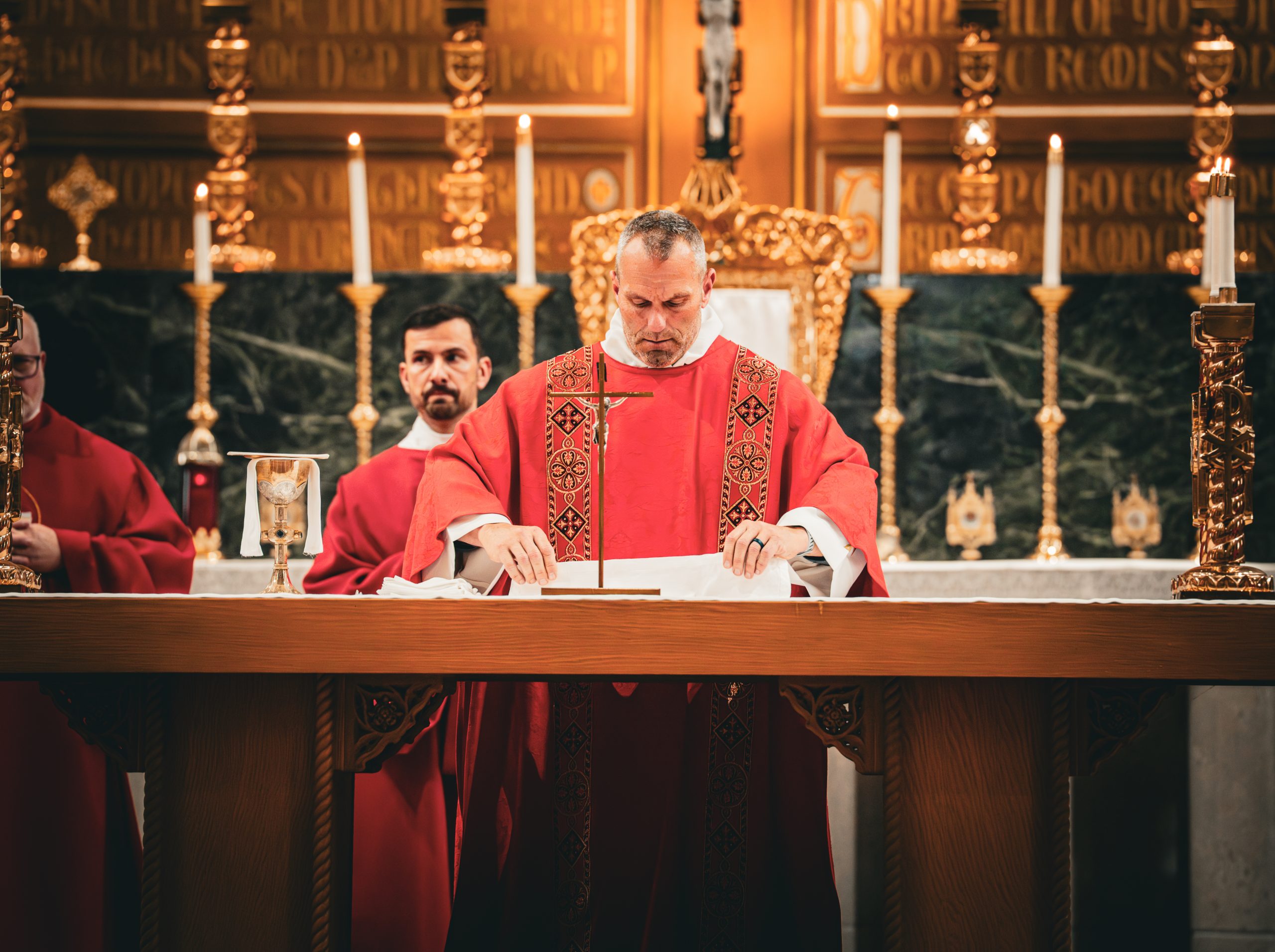
Deacons embody Christ’s love through humble service, the very spirit of the Eucharist
Chris Ruff
Director of the Office for Ministries and Social Concerns
Fifty-five of the 71 permanent deacons serving in the Diocese of La Crosse have been ordained in just the last 18 years. This is a remarkable statistic because it tells us that something that was very rare for our parishes less than 20 years ago is now quite common, especially in our larger communities. And yet, many people are still less than certain about what a deacon actually is and does.
Much could be said about the topic, but in this article, I would like to focus on one aspect – the relationship between the deacon and the Eucharist. Now, that might seem odd, because while the deacon is a member of the ordained clergy, only priests and bishops can consecrate the Eucharist. Deacons are limited to assisting them at the altar.
Christ’s Total Gift of Self
But what is the Eucharist? It is Jesus’ complete gift of self—body, blood, soul and divinity—poured out and given to us. As Jesus said, “The Son of Man did not come to be served but to serve and to give his life as a ransom for many.” How does the Son of Man serve? He serves, above all, by sacrificing Himself on our behalf and literally embodying that sacrifice in His gift of the Eucharist.
The word “deacon” comes from the Greek diakonia, which means “service.” And here the connection begins to emerge. While it is true that the deacon cannot consecrate the Eucharist, it is equally true that in his vocation, in his very being, he is called to live out the self-sacrifice embodied in the Eucharist. The very name of his vocation evidences his call to mirror the life of Christ the servant.
Here it is interesting to note that—unlike Matthew, Mark and Luke—John, in his Gospel account of the Last Supper, does not include Jesus’ words instituting the Eucharist. John has already focused on the real presence of Jesus in the Eucharist in chapter six, where Jesus tells His followers that He is the Bread of Life and that they must eat His body and drink His blood if they wish to have life within them.
John is unique in his account of the Last Supper by turning his attention to another gesture. He writes of Jesus getting up from the table, tying a towel around His waist, and washing His disciples’ feet. Jesus tells them, “If I … the master and teacher, have washed your feet, you ought to wash one another’s feet. I have given you a model to follow, so that as I have done for you, you should also do.”
We see, then, that what Jesus says of this humble gesture of love to another, he also says of the celebration of the Eucharist: “Do this in memory of me.” These two realities are inseparable. In the words of Pope Benedict XVI in Deus Caritas Est, “A Eucharist which does not pass over into the concrete practice of love is intrinsically fragmented.” This is the deacon’s calling
in a particular way.
The Many Forms of Diaconal Service
Certainly, the ministry of deacons is multifaceted. They proclaim the Gospel, preach, teach, baptize, preside at weddings and more. But deacons are called above all to be images of Christ the servant. We see this in the very origin of the diaconate in chapter six of the Acts of the Apostles. The Greek Christians complained that their widows were being neglected in the daily distribution of food, so the apostles ordained seven reputable men, “filled with the Spirit and wisdom,” to carry out this service.
The Book of Acts shows the ministry of these first deacons quickly expanding to include preaching, teaching and baptizing, as we see of Stephen, the first martyr, and the deacon Philip. But, the heart of the diaconal vocation remains the ministry of charity: humble outreach to the poor, the lonely, the homebound and the marginalized.
The next time you see a deacon assisting the priest at Mass, helping to prepare the gifts of bread and wine that will become the body and blood of Christ, remember that although he does not consecrate the Eucharist, the deacon is called to be a living expression of that holy sacrifice, in humble and often hidden service.