
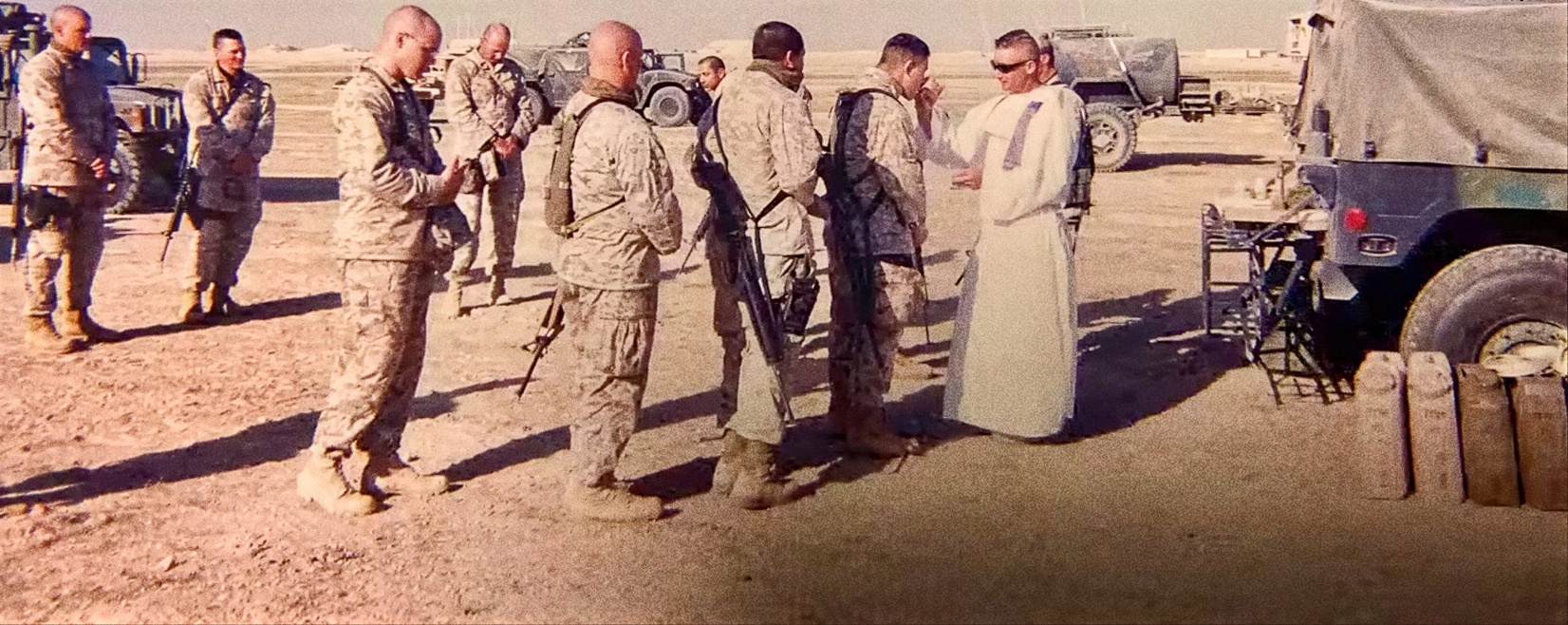
Father Conrad Targonski, OFM, carried St. Francis with him to war and now continues to carry him home
Near the end of his life, worn down by illness and nearly blind, St. Francis of Assisi composed a prayer he called the Canticle of the Creatures. It moves through creation … praising God through the sun and moon, wind and water, fire and earth, and finally Francis praises God through suffering itself and through death.
It is the work of a man who found God in poverty, isolation, pain and God’s splendor in each.
The following text captures a conversation with Father Conrad Targonski, OFM. It is framed with the same structure as Canticle of the Creatures and what it means to carry Francis’ vision forward through war, priesthood and the warrior’s seemingly endless journey back home to Ithaca.
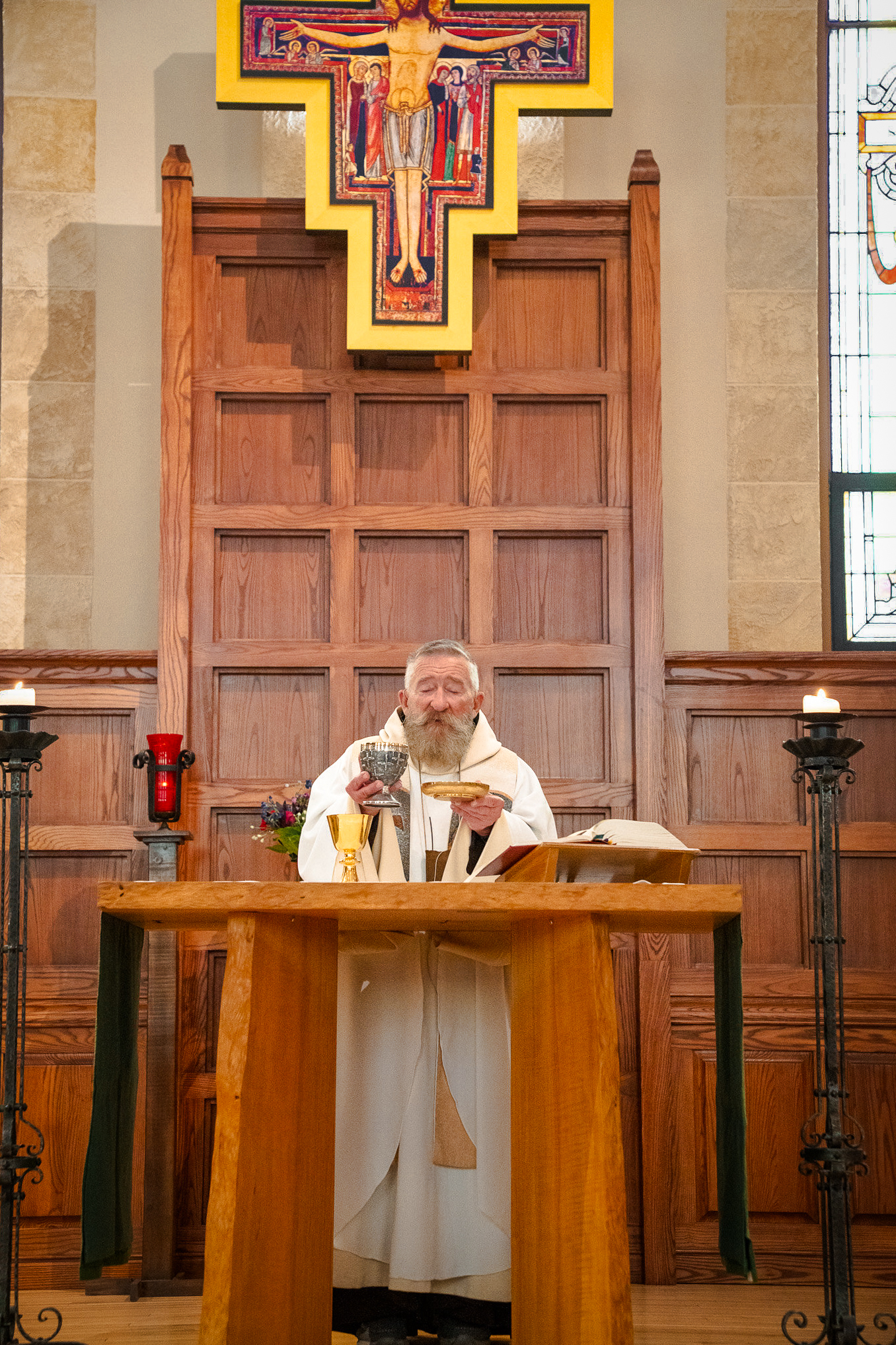
When Father Conrad’s dear friend, Kathy, learned that he was leaving Camp Pendleton to bury his mother, she asked him to bring back some of his mother’s clothes, his father’s shirts, and any old habits he had left, even the tattered ones.
From all of it, she made him a quilt and named it “The Canticle.”
“Don’t put it behind glass,” Kathy told him. “Put it on your bed. That’s your blankie.”
He still sleeps under it.
For Father Conrad, a retired Navy captain, former regimental chaplain with the Marines in Fallujah, and now chaplain at Viterbo University in La Crosse, the quilt feels especially fitting. It is stitched from his Marine dress blues, his brown Franciscan habit and the threads of both his parents’ civilian life and his own consecrated one. It is a life marked by loss and return, by war and by grace.
He has spent decades reflecting on the teachings of St. Francis of Assisi, who wrote the Canticle of the Creatures near the end of his life, and on what Franciscan spirituality offers men and women who have experienced combat. More and more, he has come to see that it speaks into that experience more deeply than most people realize.
Brother Sun: Clarity and Calling
St. Francis begins the Canticle with light. “Praised be You, my Lord, with all Your creatures, especially Sir Brother Sun,” he writes. “Who is the day and through whom you give us light.” Where, then, does a man who has been to war and back most clearly see God?
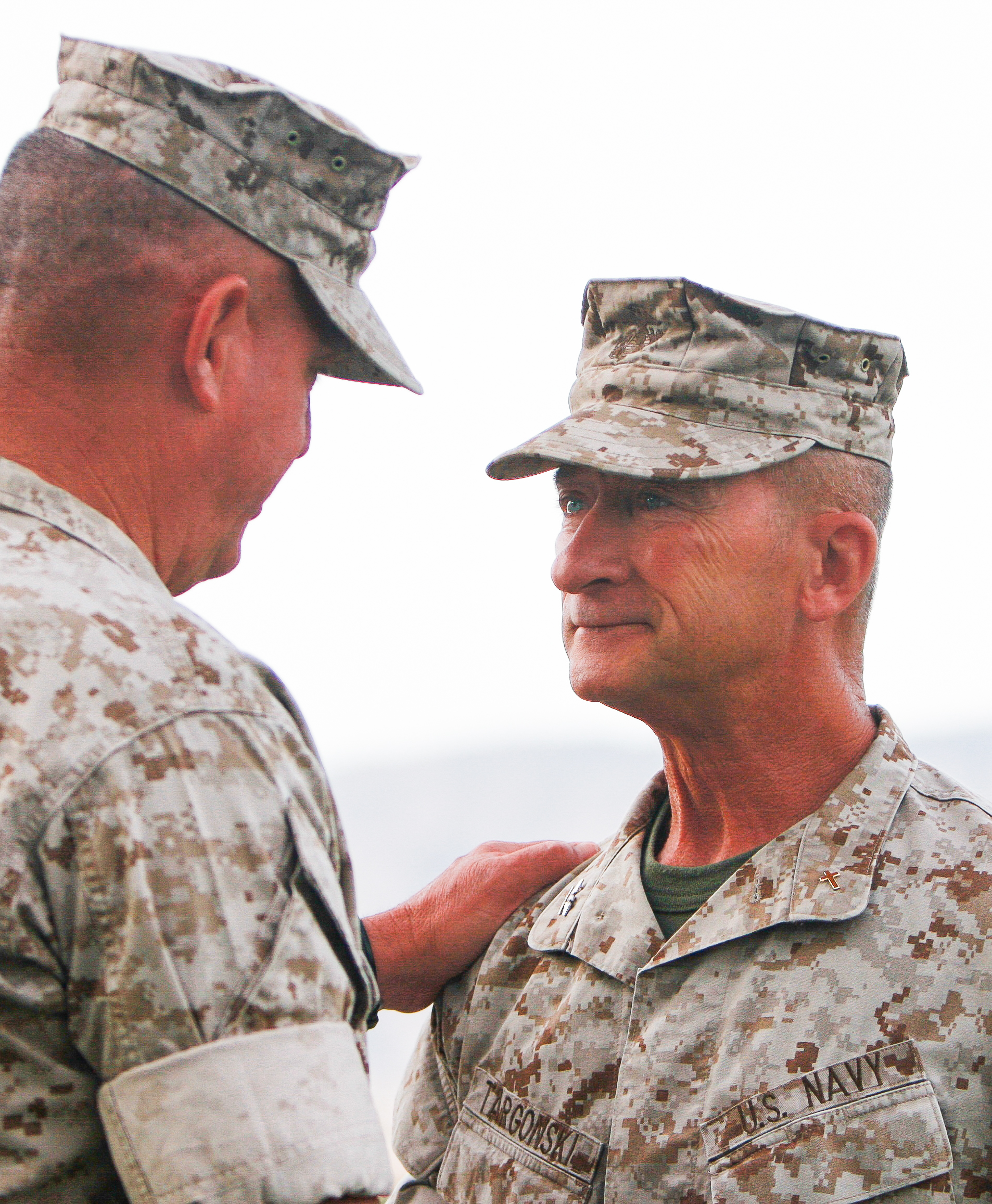
Father Conrad answers without hesitating: “The faces of people.”
He remembers that when Jesus entered Jerusalem and declared, “I am the light of the world,” the leaders turned away from His face. “Touching the face of God,” Father Conrad says, “is a principle of spirituality. The face of God reflects mercy and compassion.”
It’s why, after he retired from the Navy, he says with a smile, that his first instinct was to become a Walmart greeter. “I want to look people in the face and let them know they don’t have to carry a burden alone,” he explains. That yearning has not diminished. Father Conrad’s assuring gaze can be found at the gym, at the corner coffee shop and at the Place of Grace.
He recognizes the same instinct in St. Francis, who was himself a changed man after war. The 1972 film “Brother Sun, Sister Moon” opens with Francis returning from battle appearing unraveled.
To the men and women of today who have faced battle, Father Conrad shares that Francis’ message would be, “The God who made the sun made you, and the face looking back at you from the other side of the wire carries that same light.”
Sister Moon: Faith without Certainty
The moon and stars in Francis’ Canticle do not eliminate darkness. They cast light within it, a light that pierces it. They are faithful without being forceful, present without answering every question.
For Father Conrad, nature and the Beatitudes have sustained his faith through deployments, deaths and a brand of anxiety that can still ambush him on a given morning.
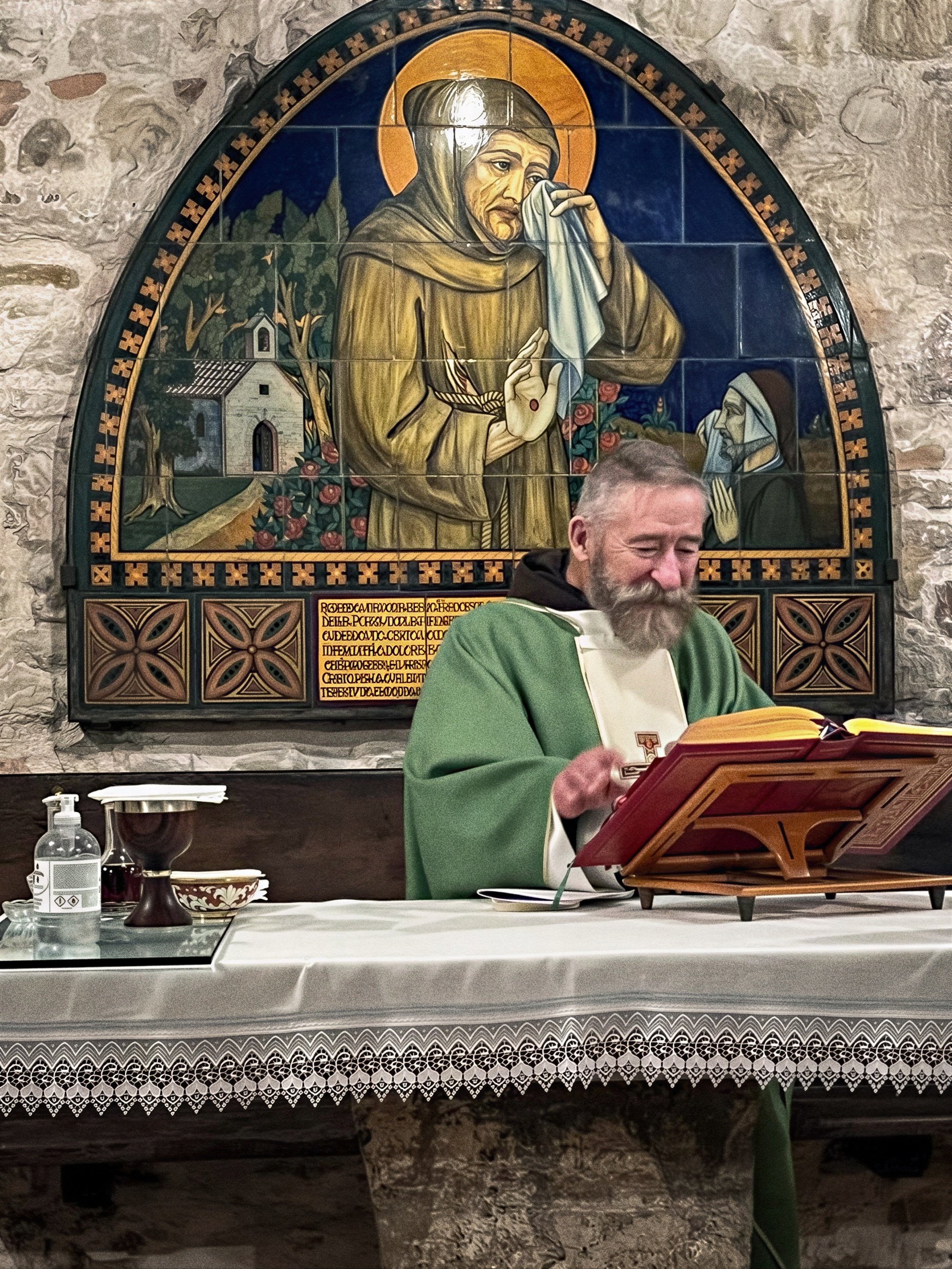
“Invariably, when I spend time in nature,” he says, “I see hope. Creation is always renewing itself, one season yielding to the next.” Over time, that pattern has reshaped how he reads the Gospel. He has come to see Matthew’s Beatitudes not as a preface, but as a map—and the rest of the Gospel as their commentary.
The Canticle praises God through the moon not because darkness disappears but because within it, clarity, preciousness and beauty come into view.
Brother Wind: Letting Go of Control
Wind can’t be directed. Francis praises God through it anyway.
Father Conrad retired as a captain from the U.S. Navy (equivalent to a colonel in the Army). He led chaplains in training and served as regimental chaplain for the Marines in the early days of the Iraq War.
He received the warning order indicating a deployment to Iraq and an accompanying feeling in the pit of his stomach. “I was trying to understand how to reconcile being a Friar Minor going to war.” His spiritual director sent him a passage from the Gospel of John: “When you were younger, you did what you wanted. When you are older, others will dress you and put you where you ought to be.” (Jn 21:18) Alongside it, he wrote: “Do not fear. I am with you.”
He packed that passage alongside his book of the Gospels and a wooden carving of Our Lady of Guadalupe he had bought in the alleys of Tijuana. The passage did not remove the fear but became a lifeline because it named what was happening. Someone else was now directing where he would go.
The tension between his rank and Francis’ radical poverty was real, but it resolved in an unexpected way. “That rank was for them,” he says of the sailors and Marines he served. With an eagle on his collar, he could walk into a general’s office and advocate for a young sailor or Marine who needed assistance and wasn’t receiving it.
In Fallujah, he was the only priest in his regiment. Of 15 chaplains, one was Catholic. He told the young evangelical chaplains he’d trained in Newport: “You have been ordained. God will provide. Step up.” And they did.
One afternoon, during pre-deployment briefings at Camp Pendleton, a sociologist who had been speaking to the Marines about winning hearts and minds pulled him aside. Formed in the Franciscan tradition, she quickly recognized his Franciscan spirituality. When she returned to the stage, she told the thousand gathered Marines: “Gentlemen, you should be excited. You’re going to Iraq with a Franciscan.”
He was not a Franciscan despite his rank. His rank became the way he lived it.
Sister Water: Healing and Humility
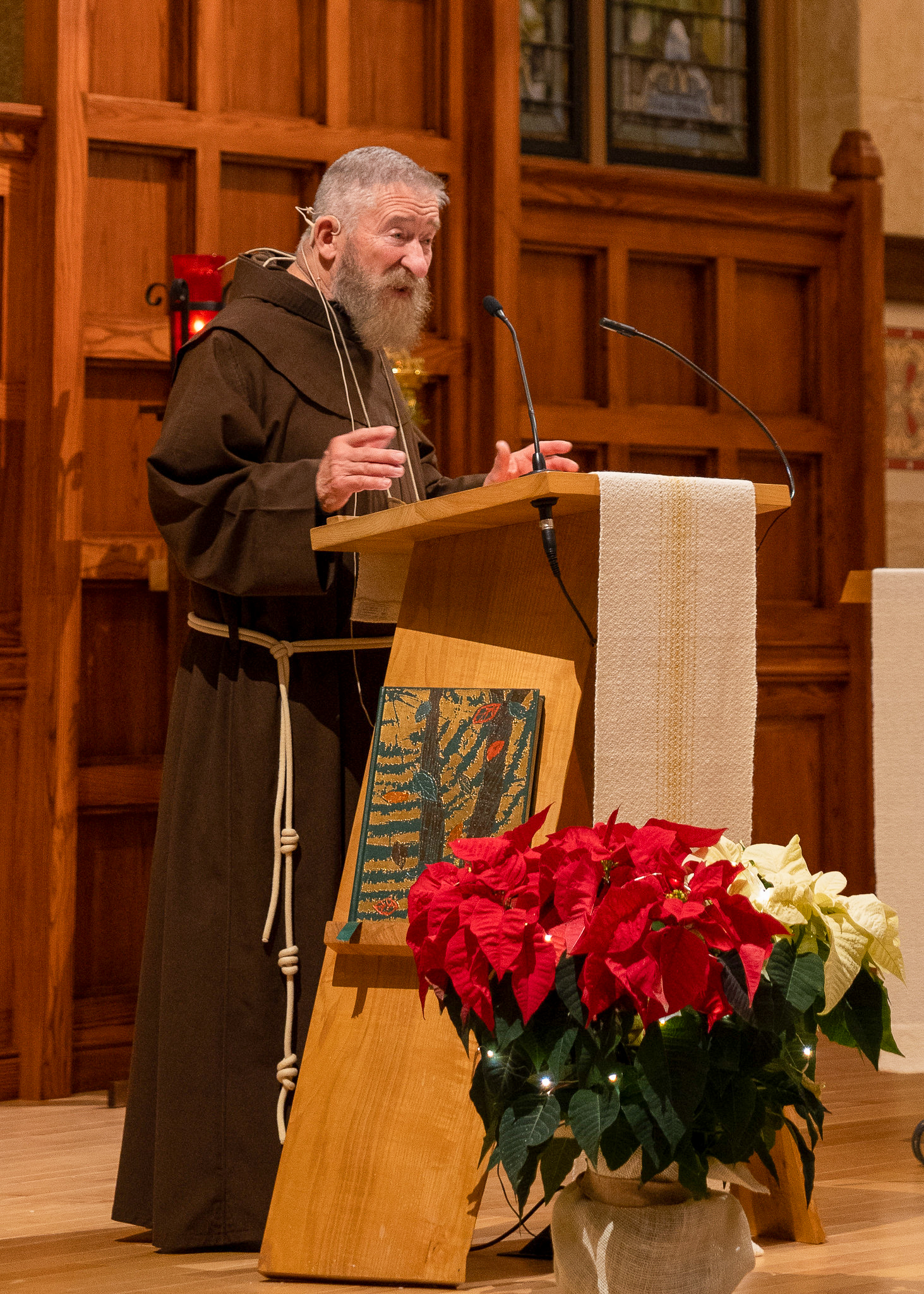
Father Conrad has led veterans’ pilgrimages to Assisi for years. When asked where real healing begins, he names four places: Poggio Bustone, where Francis returned from war and struggled toward grace; Greccio, where he revealed Christ’s humanity in a new Bethlehem; La Verna, where the stigmata came; and Gubbio.
Gubbio, in the Umbrian hills, is where Francis is said to have walked out alone to meet a wolf that had been terrorizing the town. He called him “Brother Wolf” and then simply spoke. Francis brokered a peace and when the wolf padded behind Francis back into the village square, the townspeople welcomed, fed and loved the creature they formerly considered dangerous and outcast.
For veterans who have made the pilgrimage to Assisi and visited Gubbio, the story punctures through to the soul as much, or more, than the basilicas, frescoes and sacred relics. Those returning from war can carry home a ferocity, hypervigilance and a darkness they cannot easily make known to people who haven’t lived it.
To others, these people, akin to a wolf prowling in the woods, can be “other.” And veterans can feel that otherness so deeply that even the idea of welcome, safety, fraternity and belonging is overwhelming and brings them to tears.
To hear Francis walk toward that dangerous creature and name it as brother, not as a glib euphemism
but as deep recognition, is to be met in a way the rest of the world rarely meets them. The village doesn’t ask the wolf to become a dog, hunt it down or turn their backs in fear. The village sets a place for Brother Wolf at the table.
“Every group after that,” Father Conrad says, reflecting how Gubbio became central to the veteran pilgrimages, “doesn’t want to leave.”
(“Come Here Brother Wolf,” a documentary produced and edited by Dustin Luecke during a recent veteran pilgrimage to Assisi led by Father Conrad, recently received Best Documentary honors at the Amsterdam New Cinema Film Festival.)
Brother Fire: Zeal and Passion
Fire, in the Canticle, is “handsome and robust and strong.” It gives light and heat. It can also consume. Francis praises God through it anyway.
For Father Conrad, that fire has a name: the “Office of the Passion of St. Francis of Assisi.” “That’s his fire,” he says, with a seriousness that leaves no room for metaphor. He reads it daily and keeps a copy in his truck.
He brought it with him to Iraq, alongside with the wooden carving of Our Lady of Guadalupe he had bought in the alleys of Tijuana. The carving was battered by mortar fire and was repaired again and again by a master sergeant’s hands. Several of its wooden rays are still detached and they remain that way.
This is what Francis means by fire: not enthusiasm as a personality trait but a furnace in the chest that the worst things cannot extinguish.
Sister Mother Earth: Place, Pilgrimage and Formation
After Fallujah, Father Conrad walked the Camino de Santiago. He did not plan it as a retreat. He planned to walk.
At one point, ready to quit, he nearly flagged down one of the buses that run along the route. His companion talked him out of it. They kept moving, toward bronze figures of pilgrims cut into the landscape, arms extended forward, faces resolute. A Spanish woman stopped them once. “You are walking in the footprints of people from 800 years ago,” she said. “And now they will walk in yours.”
The difference between intellectual formation and pilgrimage formation, Father Conrad believes, is that pilgrimage catches a person in the body. “You wind up somewhere different than you started,” he says. “That’s the whole goal. A vacation is organized around a destination. A pilgrimage is organized around the day-by-day.”
He now serves alongside the Franciscan Sisters of Perpetual Adoration at San Damiano Chapel at Viterbo University. From them, he has learned what persistence in prayer looks like when it is lived. “I don’t have to be on my knees in a chapel,” he says. “I can be in a mood of prayer.” Late at night, he sometimes drives past and sees the tower lit, knowing the prayers inside have not stopped. That steadiness has taught him something even war, deployment and long roads through Spain could not fully reach.
Those Who Forgive: Mercy and the Human Heart
Francis closes the Canticle with those who endure weakness and forgive. It is the hardest verse. Francis knew it too.
What Father Conrad has come to understand is that forgiveness is not a thunderclap. It is a process. It unfolds much like prayer itself, working through a relationship with God in real time.
“I’m a being in process,” he says. He still carries anger. Specific deaths. Specific failures. April is a hard month. The Battle of Husaybah was in April. Some things, he admits, he may carry to his grave. He is at peace with that in a way he was not 10 years ago. The process continues.
Sister Death: Trust and Surrender
Late one night, near the Syrian border, Father Conrad was brought to a medical van marked by green chem lights. He opened the doors and walked in. Two Marines, just recently killed, lay on litters. They had been struck by a landmine.
Their hands extended from beneath the sheets covering their bodies.
Still warm.
In the back of the van, a Navy corpsman, 18 or 19 years old, was shaking in the dark. Father Conrad spoke with him until he steadied, then prayed over the two Marines.
He speaks of this in a voice veterans use when sharing points of their military experience with another veteran that cannot be easily explained outside that shared service, with piercing depth, vulnerability and honesty.
“That embedded itself in me,” he says. April, when the memory returns most sharply, he has learned to do something different than he did for years: he sits with it rather than under it. He looks at it as something he now shares with the risen Christ, who, Father Conrad notes, always showed His wounds after the resurrection.
“Why does Jesus always show His wounds?” he asks. “He’s saying: I’m with you. I know what this cost.”
A Dominican priest, his spiritual director long since gone, once told him that what the war had done to him was a kind of stigmata. Not marks on the hands but wounds carried in the body as a conformity to Christ’s own. Francis hid his stigmata from nearly everyone. Yet what they came to mean is what Father Conrad believes wounds are ultimately for: solidarity with the suffering Christ, who is not finished walking with His people.
Final Praise: What Francis Offers Now
He is approaching 80 now. The Franciscans have asked whether he might move on to Silver Spring, Santa Barbara or perhaps Pulaski, Wis., where Franciscan friars who survived Nazi concentration camps are buried. He would like to walk among those graves. He knows some of those names. They were his teachers.
But his march is far from complete. He leads pilgrimages with passion and honor. He reads the Office of the Passion in his truck. He celebrates Mass at San Damiano Chapel at Viterbo University, and more often now than before, during consecration, something happens and the words open and he gets lost inside them. With emotion, Father Conrad describes these powerful encounters with Christ as “levitating.”
If asked what St. Francis requires of a person, not sentimentally or as a private devotion but as something lived, Father Conrad returns to the same word: compassion. But not softness. Risk. The friars who went to Mississippi in the 1950s to serve in the Delta. The friar who received a death threat and answered it with an invitation to coffee.
“You can’t justify risks,” Father Conrad says. “You just go.” Franciscan spirituality is not soft, it is a way of surviving and interpreting suffering through Christ.
That is, finally, what the Canticle of the Creatures is. It is not a poem about birds or weather but the witness of a man near the end of his life, changed by war and carrying wounds he could not set down. He looks at the world around him, at light and darkness, beauty and violence, the wolf in the woods, the sisters who pray unceasingly, the faces of those he meets and finds in all of it the face of God.
O praise and bless my Lord, thank Him and serve Him humbly but grandly!