
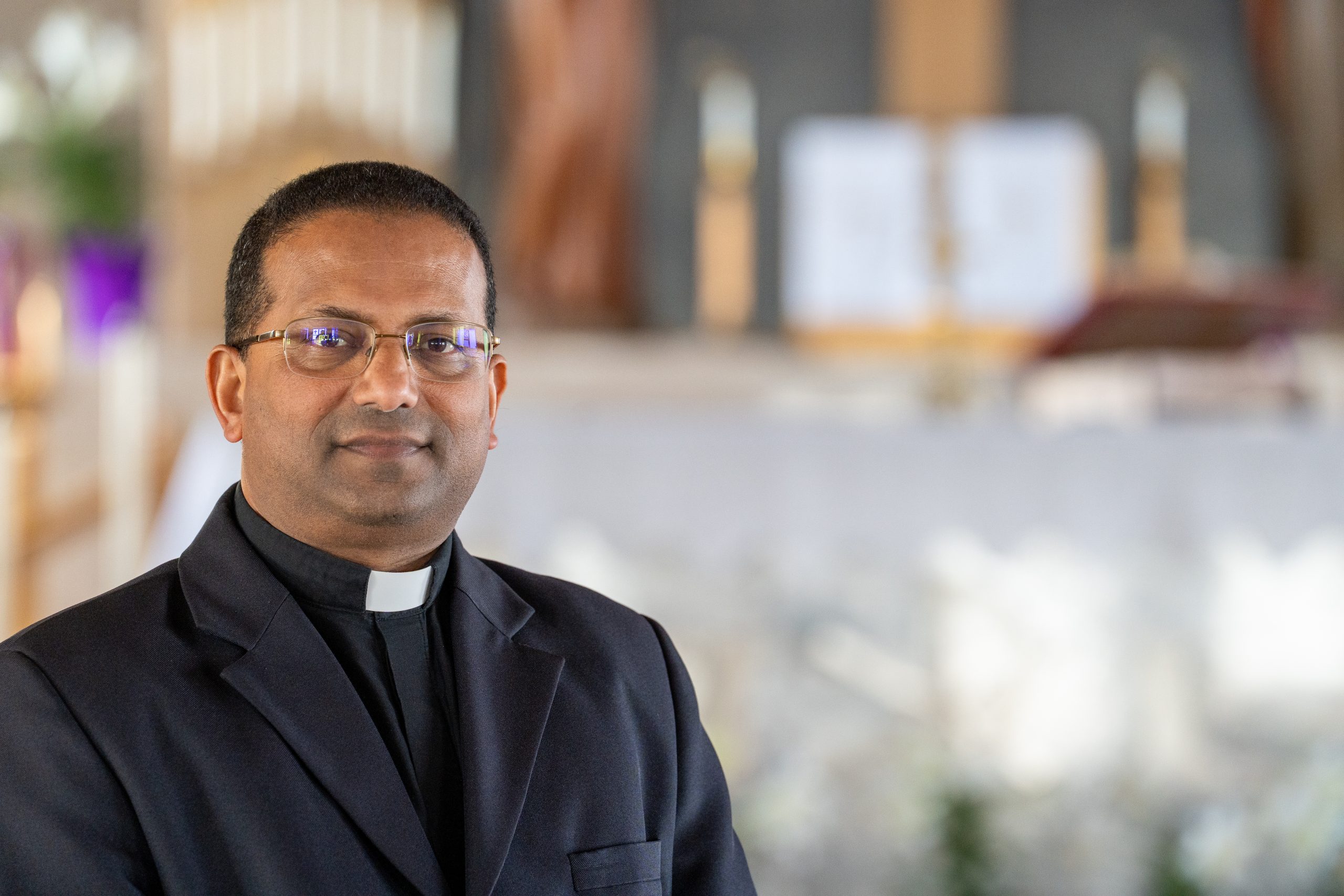
Story by Erik Archer
Editor, Catholic Life and Director of the Office for Communications and Public Relations
From the coastal villages of India to the rural parishes of Central Wisconsin, Father Biju’s priesthood has been shaped by movement, sacrifice and a quiet conviction: No soul should be lost.
When the snow finally lets go of Central Wisconsin each spring and the fields come back green, Father Biju feels something he doesn’t always expect: home.
He grew up in Kerala, a coastal state in southwest India where the Arabian Sea runs along one edge and rivers wind through dense countryside on the other. The tradition here is ancient. According to the faith passed through generations, the Apostle Thomas landed in Kerala in the first century.
The palm-fringed coast of Southern India and the dairy farms of Wood County may exist in different hemispheres, but for Father Biju, the connection is visceral. “In connection with Wisconsin, I see a lot of my place,” he says. “My place has got a lot of rivers. It’s a coastal region… we get a lot of greenery. Whenever I see the greenery after the snow is done, you get that feeling of being at home.”
Though he has been a priest for 23 years, Father Biju has never served a permanent assignment in his home state. That is the nature of the missionary life; a life defined not by where one stays but by where one is sent.
Evening Prayer and a Calling
Father Biju was born into a landscape of deep, abiding faith. In a state known for its high literacy rate and a robust Catholic presence, his family life was anchored by the rhythm of prayer.
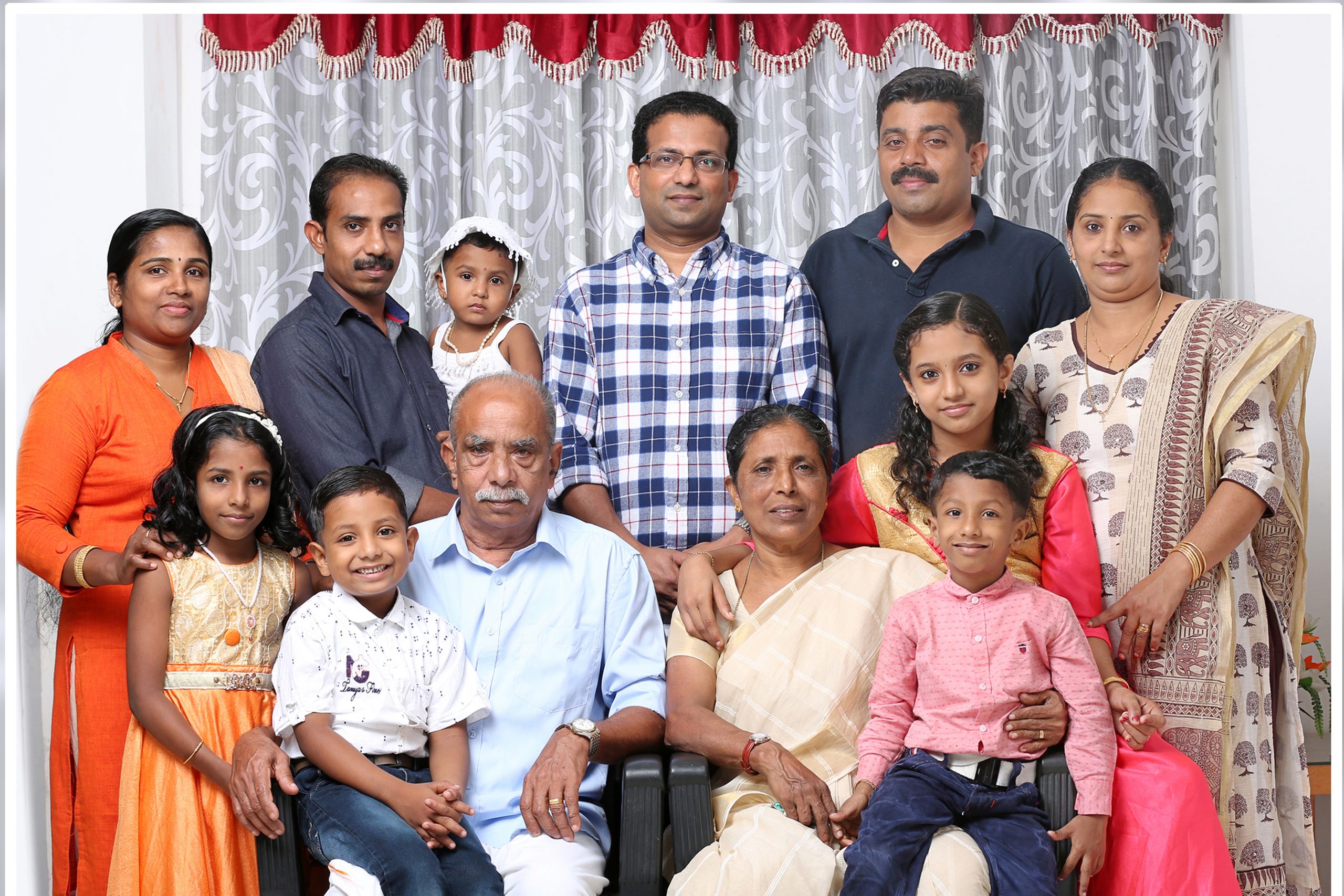
Father Biju grew up in a place where, at seven o’clock, everyone stopped for the Rosary. It wasn’t just a duty; it was the glue.
“Most of the houses, even today in my village, gather together as a family, and they spend maybe half an hour to 40 minutes praying the Rosary and reading the Gospel. My mother continues that tradition.”
When he completed the equivalent of his sophomore year of high school, he told his parents he wanted to enter religious life. His father suggested he wait, study more and make sure. Father Biju’s response was direct: “I will go. And if I am called to be a priest, I will be a priest. Otherwise, I’ll be back.”
When Father Biju felt the call to the priesthood, he didn’t just want to serve; he wanted to go. This call to go out led him to the Missionaries of St. Francis de Sales (MSFS).
The Missionary Heart: St. Francis de Sales
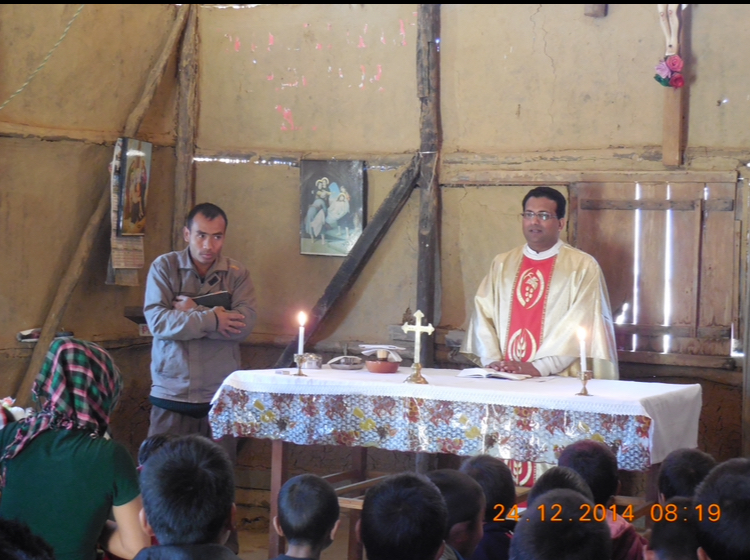
The Missionaries of St. Francis de Sales are, as their name suggests, missionaries. That meant Father Biju would leave Kerala. His first assignment after ordination was to Manipur, a state in northeast India near the Myanmar border. Three days away by train, Manipur is culturally, linguistically and ethnically a different world entirely.
In Manipur and the other northeastern states where he served, a meaningful portion of the missionary work happened on foot and was often a physical endurance test. Many villages lacked road access, and Father Biju traveled on foot to remote communities where a priest might only appear once or twice a year.
During the monsoon season, landslides frequently cut off contact with the outside world for days at a time. He lived among the people, celebrated Mass and slept in their villages. Looking back, he does not dwell on the isolation or the difficulty; he emphasizes the joy of seeing the faith take root in communities that are now producing their own priests and nuns.
That No Soul is Lost
On March 15, 2015, Father Biju’s missionary journey took its most dramatic turn. He landed at O’Hare International Airport in Chicago on what was his first international flight, taken alone, arriving in the grip of a Midwestern March.
He then spent six years as a chaplain at Sacred Heart and St. Joseph hospitals in Eau Claire and Chippewa Falls. The hospital setting is a unique laboratory for the soul. There, he met people at their most vulnerable and guarded. He often encountered individuals who had distanced themselves from the Church decades prior. When he asked why, the answers were often heartbreakingly simple: a perceived slight or wound from a priest, a moment of feeling unwelcome or a wound that never healed.
“Whenever I hear those stories,” he says, “I tell myself: This will be one of my goals. Not to lose any soul because of my attitude—because of the way I connect with people.” It is a commitment to ensuring that the human element of the priesthood never becomes a barrier to the divine. It is not a statement made lightly. It reflects an awareness that the way a priest speaks, listens and responds can have lasting consequences. It also reflects a commitment to approach each person with care, recognizing that their story may be more complicated than it appears.
“Every soul is precious,” he says.
After his chaplaincy and a subsequent six-year term in parish ministry at St. Joseph in St. Joseph Ridge and St. Peter in Middle Ridge, Father Biju arrived at his current assignment in April 2025. He now serves as the pastor for the tri-parish community of St. Michael in Junction City, St. Bartholomew in Mill Creek and St. Wenceslaus in Milladore.
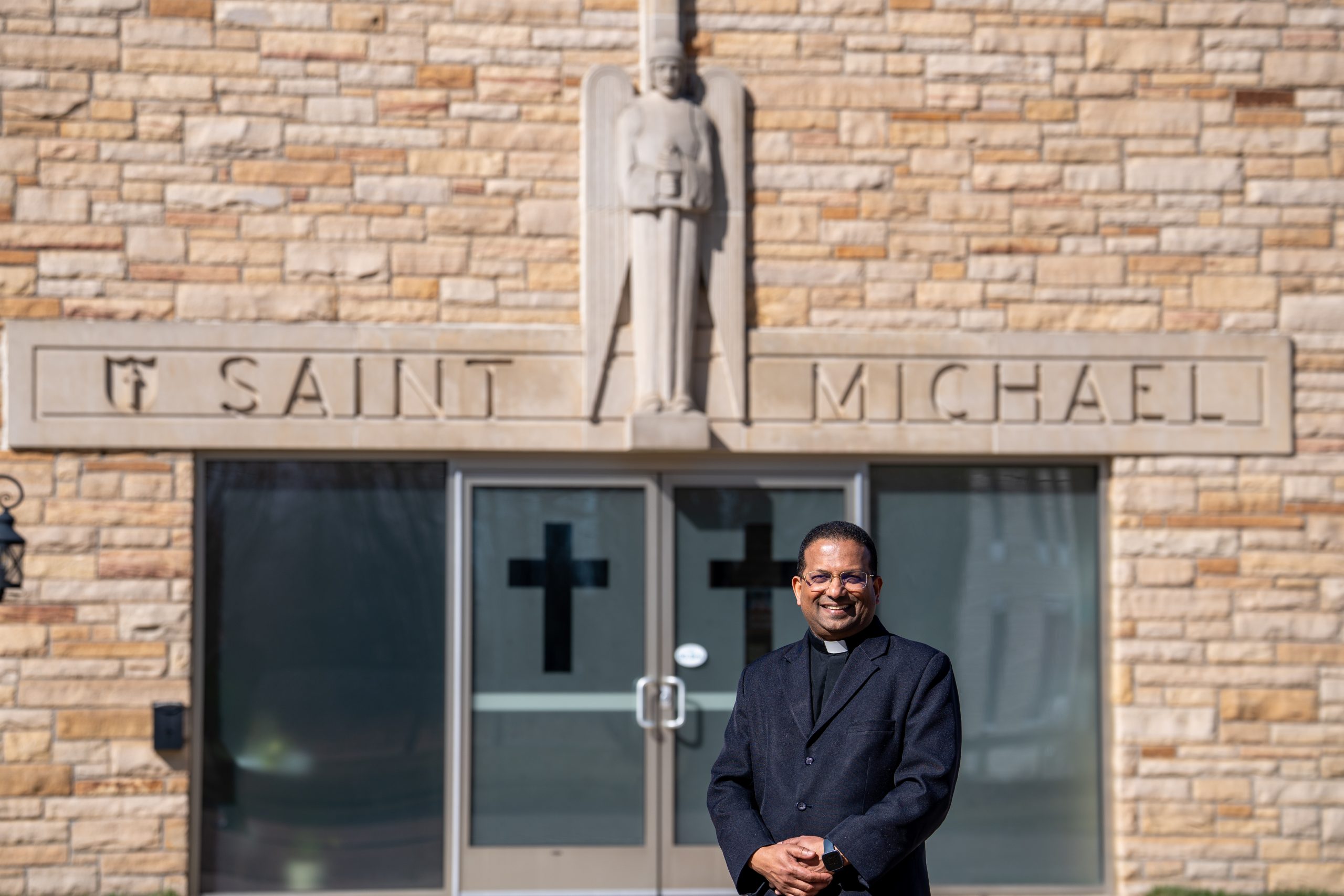
Pastoring three distinct communities is a logistical challenge, but those who work alongside him say Father Biju has a natural instinct for connection. Chris Hollar, the parish secretary at St. Michael and St. Wenceslaus, notes that his presence was felt almost immediately.
“Come on In”
One morning during a storm that had closed the church before Sunday Mass, Father Biju was preparing to sit down for breakfast at the rectory. A knock came at the door. A person had walked through the storm, not for an emergency but because they wanted to go to confession. Father Biju opened the door to the storm.
“Come on in,” he said with a smile. The sacrament was offered and received, and then Father Biju put on a pot of coffee and they sat down. In that moment, the missionary heart was on full display.
Basketball and Bitter Melons
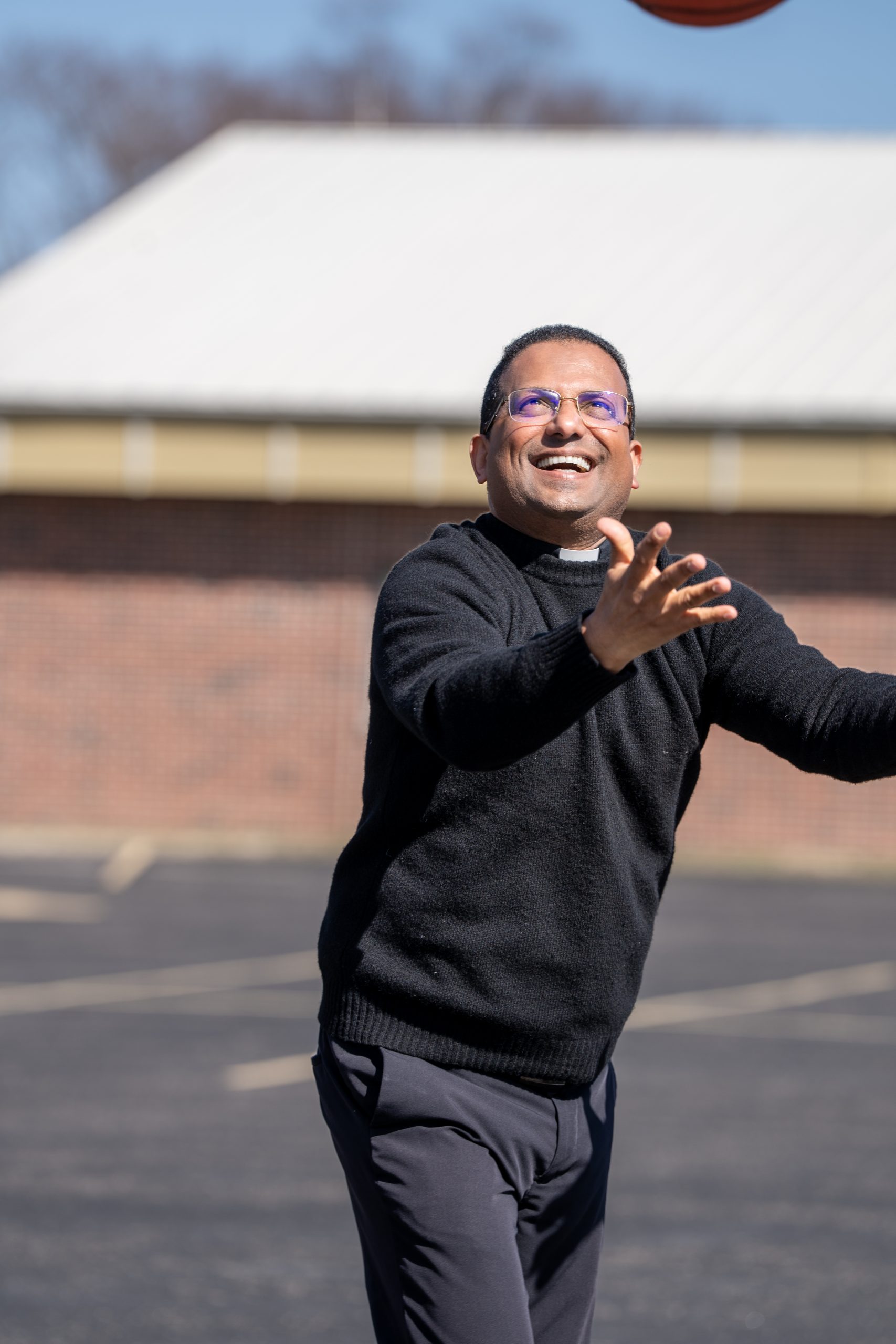
If you want to know the real Father Biju, you have to look past the Roman collar and toward the basketball hoop behind the rectory.
When Father Biju first arrived at his current assignment about a year ago, Chris noticed something in his luggage. “I saw the basketball and asked, ‘Hey, so you shoot hoops?’” she recalls.
Within weeks, and thanks to many generous souls, the parish installed a sturdy slam-dunk ready hoop.
Away from the basketball hoop and behind the rectory, Father Biju tends to a little piece of Kerala in the Wisconsin soil: peppers, beans and bitter melons (a.k.a. bitter gourd). He cooks, gardens and maintains a close connection to his family back home, visiting his brother, sister and five nieces and nephews once a year.
A Life of Purpose
The transition from the shores of the Arabian Sea to the bluffs of the Wisconsin River is a testament to the universal nature of the Catholic Church. Father Biju is a reminder that the same Rosary prayed at seven o’clock in an Indian village is the same Rosary prayed in a farmhouse in Junction City.
“It’s like a family gathering together for worship,” Father Biju says of his weekend Masses. “I see the faces. I recognize them… it definitely feels like I belong to a community.”
He is a missionary who loves a physical game of basketball, a gardener who misses the monsoon rains but appreciates the Wisconsin spring and a priest who refuses to let a storm stand between a parishioner and the sacraments.