
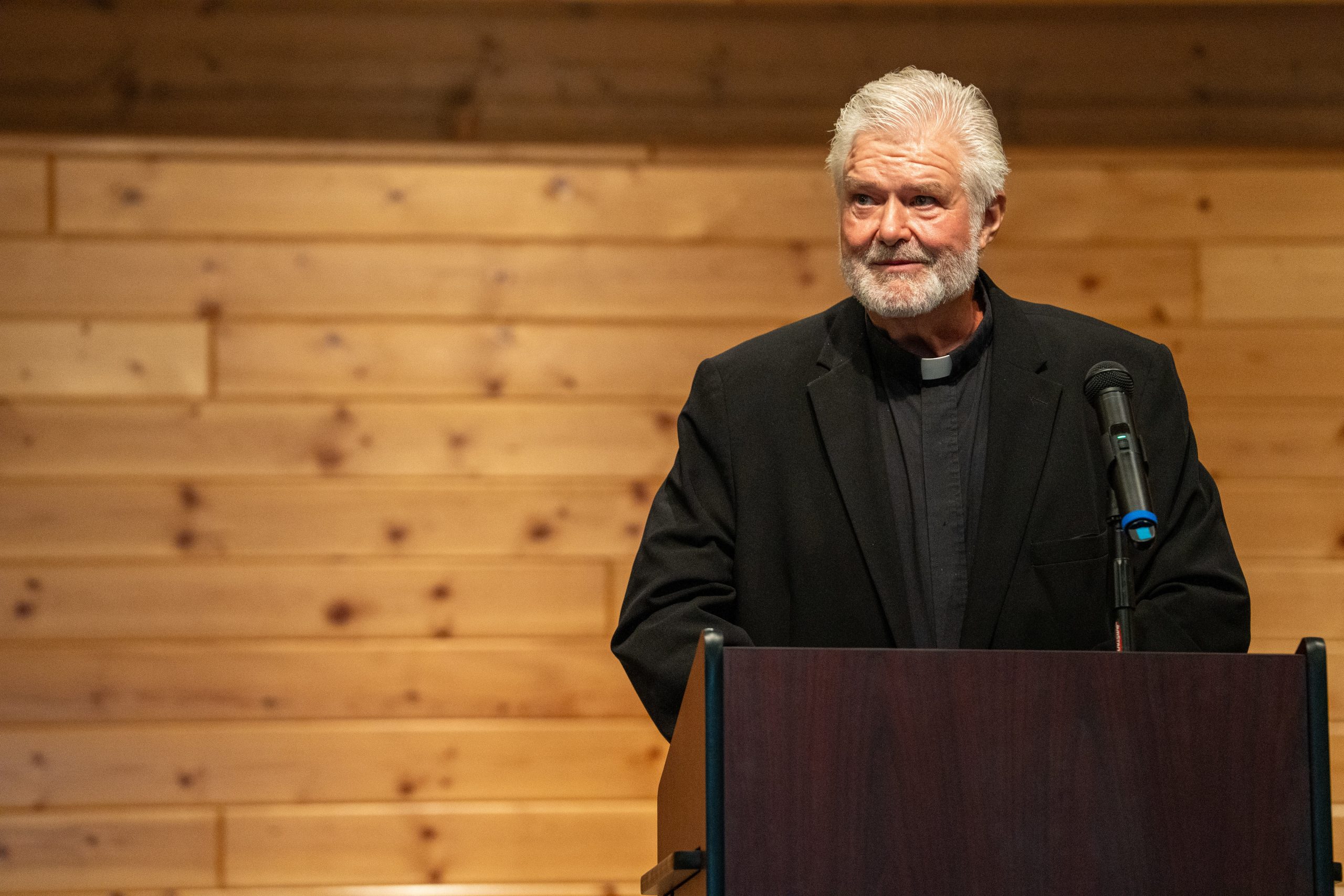
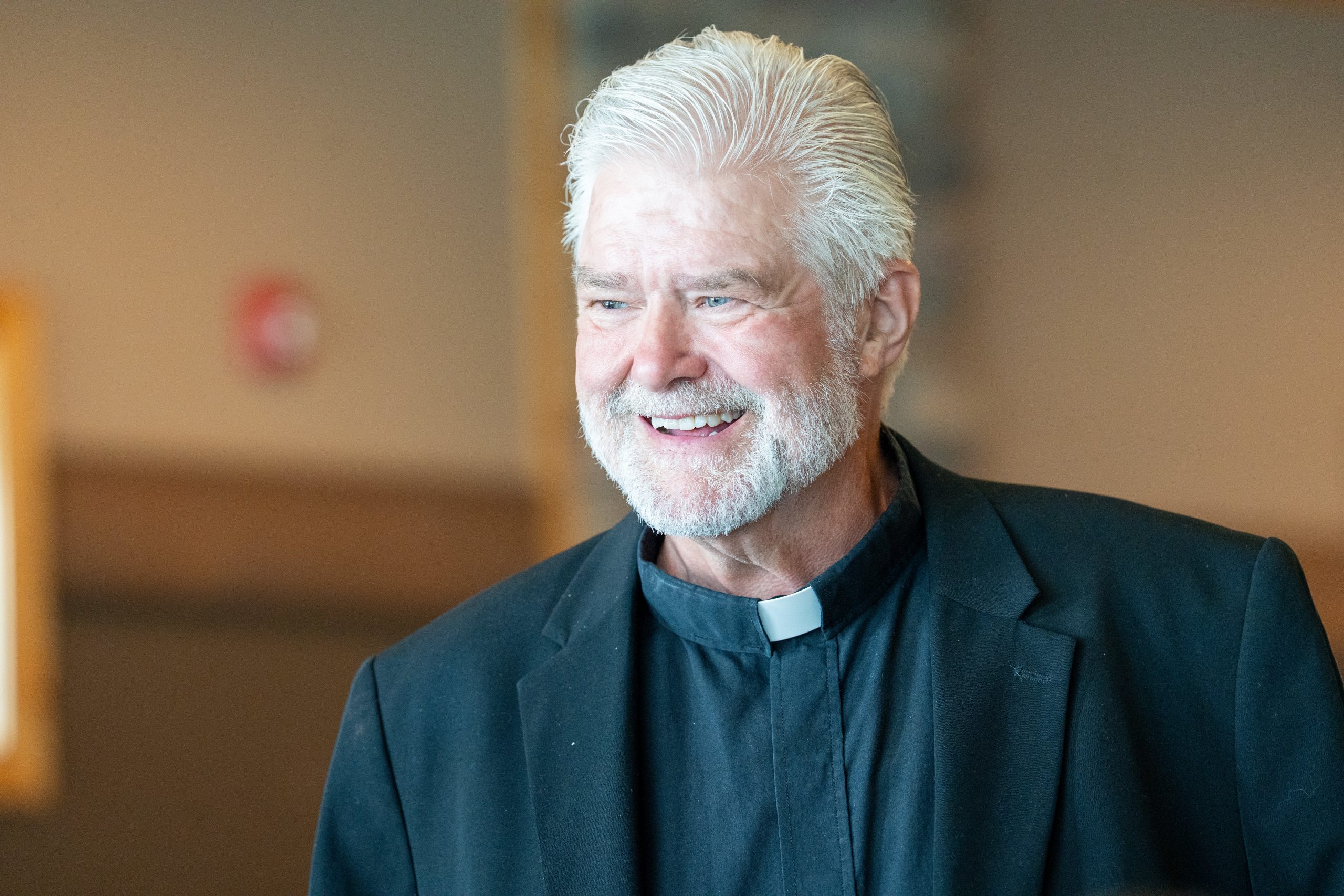
Monsignor Roger Scheckel Reflects on 41 Years of Priesthood
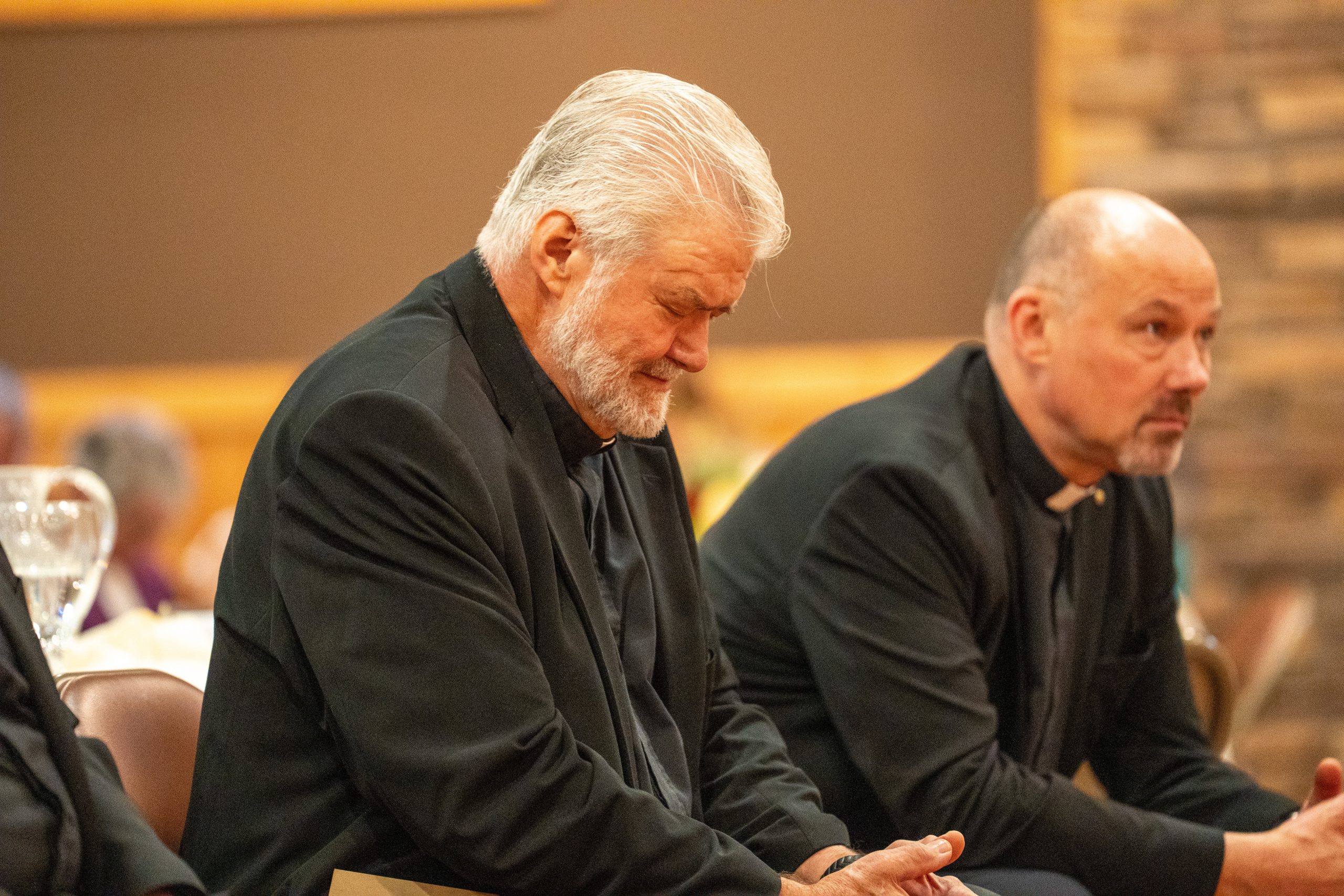
The reflections that follow were delivered by Monsignor Roger Scheckel at his retirement celebration, marking the close of 41 years of priestly ministry. Rather than offering a summary of assignments or a catalog of accomplishments, Monsignor Scheckel chose to speak about the moments that formed him: a childhood accident on a family farm, a vocation first named and later tested, the cost of keeping Catholic schools alive, the demands of pastoral leadership and the quiet weight of sacramental ministry.
Ordinarily, Feature a Pastor takes the shape of an interview. In this case, Monsignor Scheckel’s remarks required no such framing. Presented here substantially as given and only lightly edited for clarity, they stand as a singular meditation on vocation and fidelity. What emerges is not simply the story of one priest, but a reflection on what it means to be entrusted, over a lifetime, with what he ultimately names as an absolute good.
A Formidable Man
Deacon Tully’s Introduction
A few days before my ordination, I received my “orders,” as we called them in the military. My assignment was to the Assumption of the Blessed Virgin Mary in Richland Center.
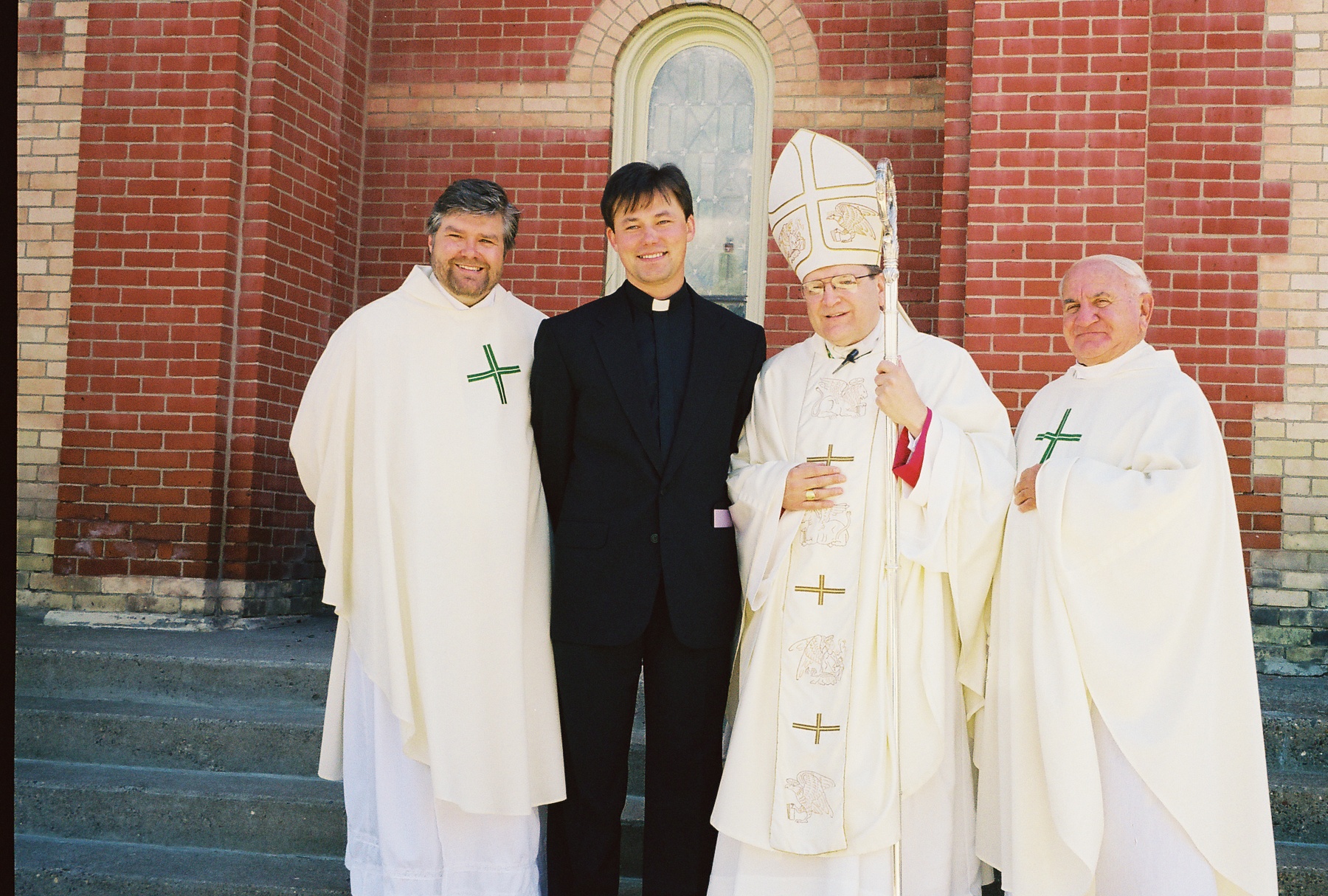
I was surprised, so I called a priest friend to tell him the news. I said, “I’m going to be in Richland Center.” He said, “Oh, that’s Monsignor Scheckel. Do you know him?”
I said, “Well, no. Only by name.”
Then he said something I have never forgotten: “Monsignor is a formidable man.” When I hear a man described as formidable, I go to the physical right away. I’m thinking six foot two, 250 pounds, broad shoulders, athletic build, firm, crushing grip.
And when I first met Monsignor, he did not disappoint. Physically, he conveys, as we all know, a sense of strength and stability. But it didn’t take me long to see beyond the physical. It really didn’t, because I soon realized that there were deeper elements of this man’s character that defined him.
I found him to be a man of gravitas, not in an intimidating way but in the dignity with which he carries himself.
His voice, as we know, commands attention, doesn’t it? But not because of his volume or sternness, but through clarity and conviction and well-mannered authority. Whether he is presiding at the altar, sitting in confessional or counseling someone in the privacy of his own living room, he radiates a quiet sense of confidence and reassurance, a man who is deeply rooted in Jesus Christ.
“Formidable” used in this context suggests a profound respect. Monsignor, as we all know, is a man of much substance intellectually, spiritually, morally. You who know him know that he is a man who is firm and yet compassionate. He doesn’t shy away from the hard truth, but at the same time, when he speaks it, he speaks it with pastoral charity.
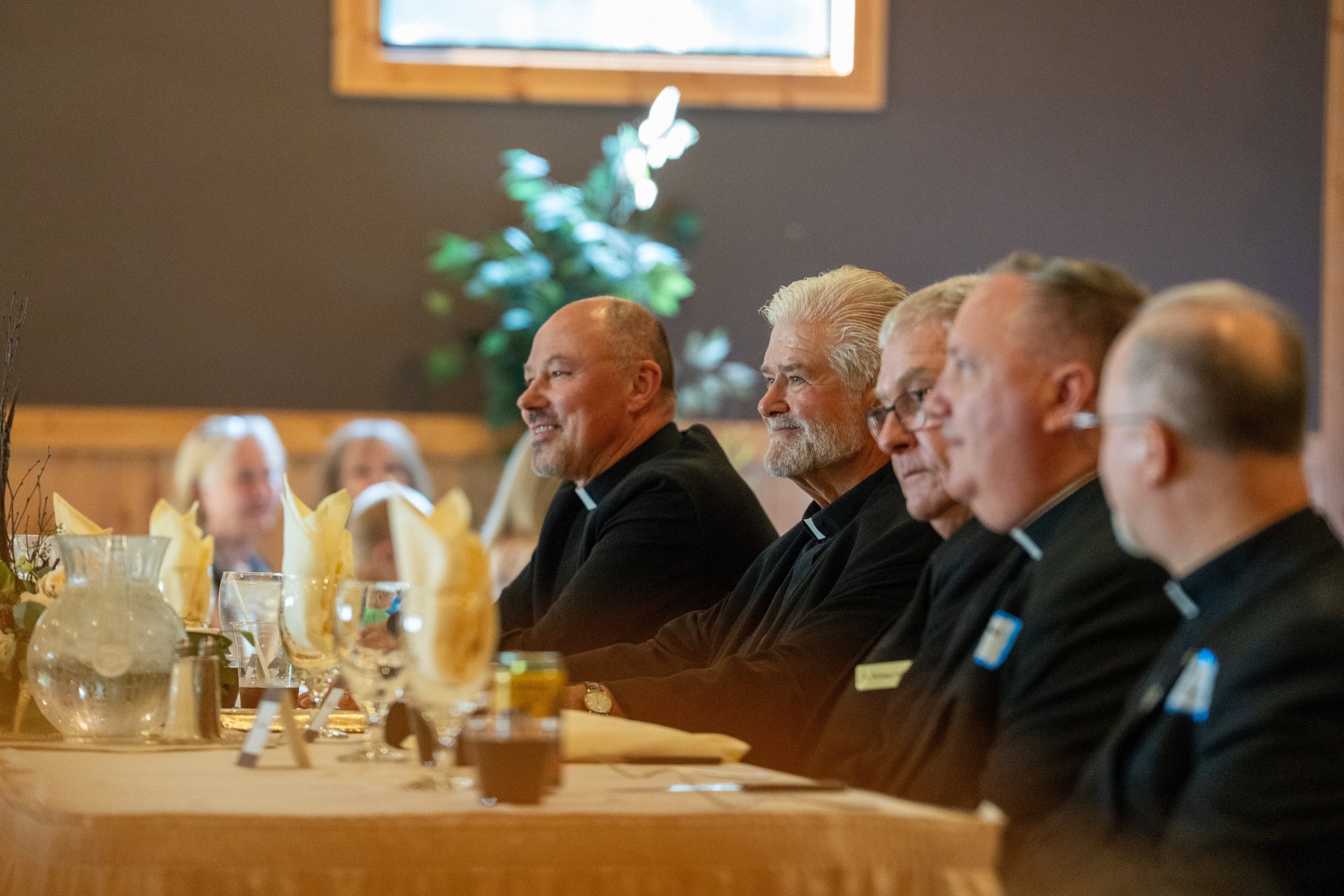
Let me just close with this.
When a man seeks ordination, when he seeks the sacrament of holy orders, his formation is built on four elements: the human, the spiritual, the doctrinal and the pastoral. And Monsignor Scheckel learned all these elements in his formation years in the seminary, for sure, but he also embodied and exemplified them throughout his 41 years in the priesthood.
And it’s his character, his deep sense of vocation and his very evident love for Christ and His Church that makes him truly formidable.
When Bishop Callahan surprised me with my assignment to St. Mary’s in Richland Center, he gave me a gift that I didn’t even know I wanted. And it was a gift: the blessing of serving God’s people side by side with Monsignor Scheckel.
The Beginning of a Vocation
Monsignor Roger Scheckel
I want to begin with sharing something significant in my journey to the priesthood.
It happened when I was 3 years old while growing up on the family farm in Wauzeka. I had a toy helicopter with a mechanical base so that if you turned its rubber tires the propeller turned. As a 3-year-old I was quite enamored with it.
In the mind of a three-year-old, there was no better place to make those helicopter tires turn than running them up and down the tires of the tractor that my dad was using at that time to clean out the milking barn. The tractor was an Allis-Chalmers WC with a narrow front end.
I positioned myself down on my knees, facing the two front tires, running my helicopter tires on the tractor tires. My father came out of the barn to move the tractor and the manure spreader forward. Without seeing me, he ran me over with my head taking a direct hit.
He later said that when he heard me cry out and saw that the tractor tires were directly on top of my head, something told him not to put it in reverse and back up but to continue forward, which he did, pushing my head deep down into the soft manure that was present around that part of the barn.
My father picked me up, carried me into the house, telling my mother to come while he got the car to take me to the closest hospital in Boscobel.
The hospital at that time did not have a surgeon on staff, but that day a Dr. Randall, who was a surgeon, had been called in for a particular case and was there when I arrived. While I underwent surgery for a serious skull fracture, my parents went to Immaculate Conception Catholic Church in Boscobel to pray.
When my parents returned to the hospital, they were told that I had survived but that very likely there would be some cognitive damage because of the head and brain injury. However, it turned out that because the bones of my skull were still soft and pliable at the age of 3, rather than being brittle, when my skull fractured, the fragments did not penetrate deeply past the brain lining.
After a number of days in the hospital, I was able to return home. My parents watched me closely for any evidence of brain damage. Even though my siblings would claim that there was certain evidence of brain damage, not only then but throughout my lifetime, to the relief of my parents, especially my dad, I appeared to be normal.
“Just Because You Made a Promise”
In 1982, I had driven home to the farm for Christmas vacation from Washington, D.C., where I was attending seminary, and it was two years before I would be ordained a priest. When my dad, Virgil, went to bed early, my mother, Evelyn, and I stayed up to talk.
During our talk, she shared that a number of months after I had returned home from the hospital from the skull fracture, I told her that when I was asleep in the hospital, “Jesus came to me and told me that I was going to be okay,” but then also told me he wanted me to be a priest and asked me if I would do that. And I told him, “Yes I would”.
Now, I have no recollection of this vision or dream or whatever it was. Nor do I have any recollection of telling this to my mother. The only person she told was my dad, and the two of them had agreed that they would not bring it up to me unless it became evident that I was being called to be a priest.
At the time of this conversation with my mother, I had been in seminary formation and studies for 11 years. I was two years away from being ordained. So that night, my mother chose to reveal this matter to me. This was the first time I learned about any of this, but it finally shed light on an encounter I had with my dad in 1969, following my 8th-grade graduation from Wauzeka school and after I had written the entrance exam and had been accepted to enter Holy Cross Seminary High School. My two older brothers had both left the farm, Mike entering the Navy and Jim entering college. In my dad’s mind, I was to work beside him the next four years.
If my dad ever had something he wanted to talk to you about, my siblings can confirm this, he would ask you to come and then would say to you whatever he had to say.
However, on this occasion, my father did something very different. He came upstairs, entered my bedroom and sat down on my bed beside me. It was very unusual for him to do something like this. I remember clearly what he said to me, “Roger, just because you made a promise when you were a little boy, doesn’t mean that you have to keep it.”
Then he stood up and left the room.
I did not have a clue as to what he was talking about. I remember my heart rapidly beating. Before that day I never had my dad sit down alone beside me and have a one-on-one conversation. But it had just happened, and I had no understanding of what he was talking about and for whatever reason I chose not to question him.
“And for me, that Someone is Jesus Christ”
So now, 11 years later, after this conversation with my mother, finally I understood what that conversation with my dad was about.
I have since referred to what happened at the time of the tractor accident as the primordial point of my vocation to the priesthood. That is the earliest and first movement in my vocation. It was a movement that remained and grew over time. Ever since I was a child and all through my growing up into adulthood, I’ve always had a strong sense that I was to be a priest.
And I can tell you that in the course of my 41 years as a priest, there has never been a day, or a moment in a day, that I have ever questioned or lamented the fact that I am an ordained priest.
I believe that something very real and true transpired in my soul at the time of that tractor injury, and I’ve come to recognize and believe that my becoming a priest came about because of someone above and beyond me. And for me, that someone is Jesus Christ.
Formation Through Encounter and Justice
After the high school seminary closed in 1971 for lack of enrollment, I transferred to St. Francis DeSales High School in Milwaukee where I graduated and then went on to attend St. Francis College Seminary at the same location. It was during my two years at the college seminary that I experienced a lasting formative experience orchestrated by John Kinsman Sr., who was from Lime Ridge. John was a farmer who, as a Catholic, was deeply committed to works of justice and charity.
He began a program called Project Self-Help and Awareness (PSA), which involved a child and student exchange program between Wisconsin and Mississippi. It included approximately 10 bus trips each summer that brought black children to Wisconsin and took white children to live in Mississippi, promoting understanding and friendship between the races. This program had a profound effect on my formation and that of many other seminarians. I’m deeply grateful.
My involvement with PSA eventually led me to living and working on the Bogue Chitto Choctaw Indian Reservation, near Philadelphia Miss., in the summer of 1975. The following summer, it led to my studying at the Martin Luther King Jr. Center for Nonviolent Social Change in Atlanta, Ga.
After completing two years of study at St. Francis college, I received a scholarship to study philosophy for three years at the Catholic University of America in Washington, D.C. I participated in what is known as the Basselin program. It was a challenging program that led to the conferral of a master’s degree.
“Toying with a Divine Calling”
After completing these three years, I decided to take a break from academics before continuing the last four years of study required for ordination.
To leave seminary formation involved my meeting personally with our diocesan bishop, Bishop Frederick Freking. Ordinarily such a meeting involved the bishop revealing where he would send a seminarian to study theology, the last four years of formation before ordination.
When I told him I was going to take a two-year hiatus in seminary formation, he was noticeably disappointed. He asked me if I was uncertain about my vocation, and I told him immediately, “Oh, no, bishop. I know that God is calling me to be a priest.”
I vividly recall the look on Bishop Freking’s face, and I can to this day hear his rather stern voice and his finger pointing in my direction across the desk, saying, “Young man, you are toying with a divine calling.”
I apologized because I knew he was disappointed, but I told him that my mind was made up, and then I said, “Bishop, I will be back in two years.”
I traveled for seven months, five months by motorcycle and two months by rail throughout every European country west of the Berlin wall. It was a wonderful adventure, and when it was over I was ready and eager to return to seminary studies and formation.
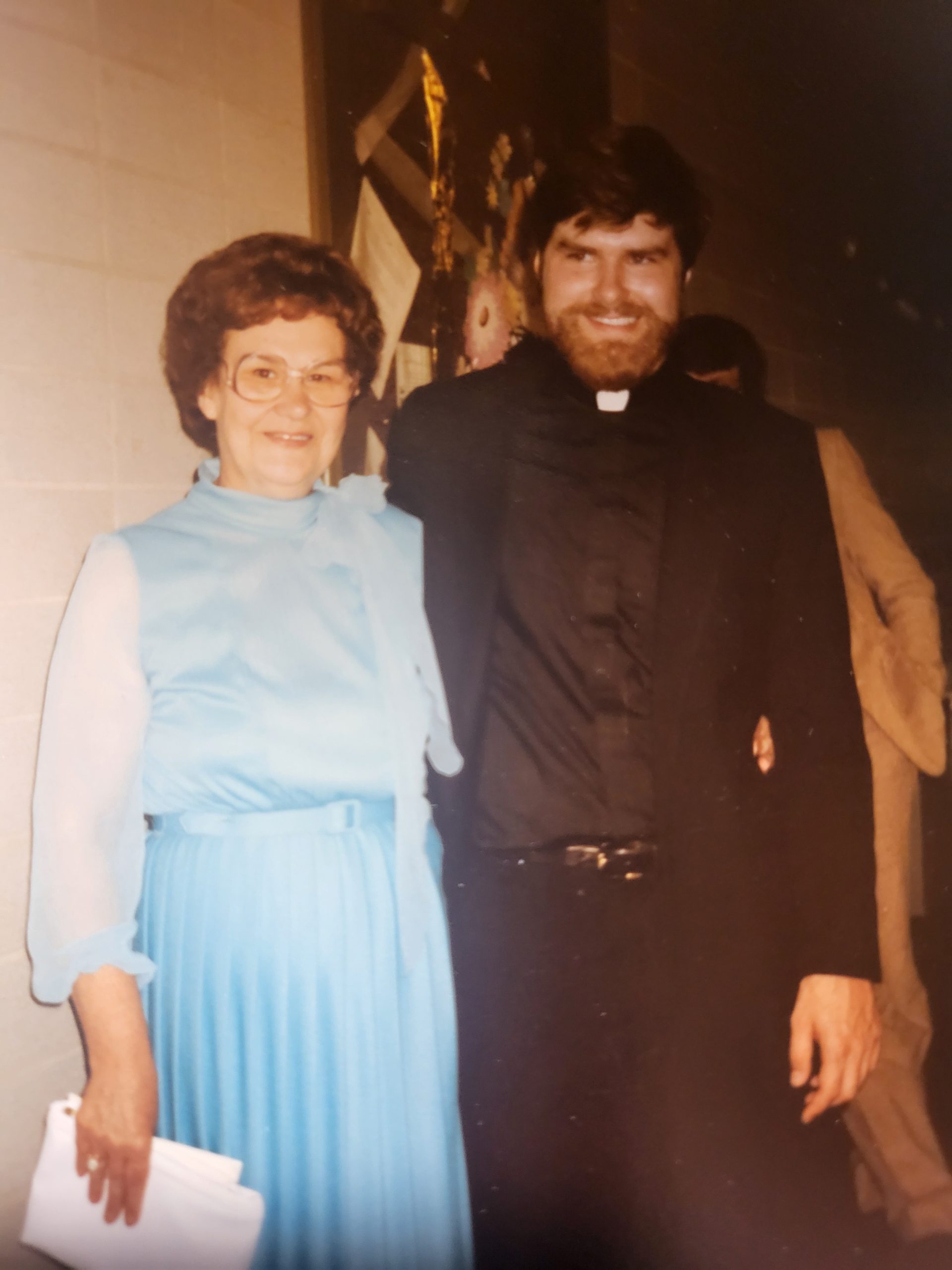
I was ordained four years later at the cathedral in La Crosse on May 26, 1984, by Bishop John Paul, who had replaced Bishop Freking as our diocesan bishop. Two months to the day of my ordination, my father, Virgil died of stomach cancer. I felt deeply for my mother on the day of my ordination, seeing her present in the front pew of the Cathedral without my father. It was apparent to me it was a day of joy and sadness for her.
The Cost of Keeping a School:
Effort, Sacrifice and Creativity
In 1987, after three years as an associate pastor at Blessed Sacrament Parish in La Crosse, Bishop Paul appointed me the pastor of three parishes: the Nativity of the Blessed Virgin Mary at St. Mary’s Ridge; St. Augustine Parish in Norwalk; and St. John the Baptist Parish at Summit Ridge, located approximately 10 miles from Sparta.
There was a Catholic school at St. Mary’s Ridge with 17 students in grades 1-8. Bishop Paul instructed me to go and study the situation and bring to him a recommendation to either keep open or close the school.
When I arrived there, I found an unpublished manuscript recording the history of the parish. It documented the great effort and sacrifices that each pastor provided to maintain Catholic education in this rural area. It became apparent to me that I should not exempt myself from making such an effort and sacrifice. I told Bishop Paul that I would like to attempt to keep the school going.
It required a great amount of effort. The first thing needed, I believed, was the three parishes becoming united in supporting the school with children and monetarily. Securing this unity was a challenge, but it was eventually achieved.
Transporting students to the school was another challenge. One of the answers was purchasing a 24-passenger, black-and-white, used school bus that would pass inspection when the state troopers would come every three months to inspect it. Whenever I saw their cruiser arrive at the parish, I said special prayers that we would pass inspection, and we did.
I also had to successfully pass the test for a license to drive the bus. I secured my license a week before school started, and so “Buster the Bus” came about, named by the students who rode each morning and evening, praying the Rosary together as we traveled.
Mission Work and Pastoral Milestones
In 1995, our newly appointed diocesan bishop, Bishop Raymond L. Burke, asked me to come to the City of La Crosse to serve as the pastor of St. James on the north side of La Crosse. When I left St. Mary’s Ridge, the Catholic school had enrollment of 53 students.
I served for 16 years as the pastor of St. James, from 1995 to 2011. I also served as the dean of the La Crosse Deanery for six of those years.
While pastor of St. James, Bishop Burke asked that I also serve as the director of the diocesan Mission Office. When Bishop Burke was transferred to become the Archbishop of St. Louis. Bishop Jerome Listecki became our bishop. One of his initiatives was to develop relationships with bishops in India and Africa, where there are plentiful vocations to the priesthood.
Because the Mission Office was a place where bishops of other countries like India and Africa often made contact with dioceses in the United States, this resulted in Bishop Listecki and I traveling to India and a year later to Ghana. This provided an opportunity for Bishop Listecki to speak directly with bishops about the possibility of sending some of their priests to serve in the Diocese of La Crosse.
One of my initiatives while pastor at St. James Parish was a restoration of the church’s nave and sanctuary, seeking to return it to its original dignity and beauty. It was a significant undertaking and well received by the parishioners.
One of the better compliments I received was when a parishioner came into the church and observed the renovations for the first time. He said to me: “Father, you spent our money well.”
Richland Center and Gratitude
When Bishop William Patrick Callahan became our bishop in 2011, he told me that I had been at St. James Parish long enough, 16 years, and that I would be sent to the Assumption of the Blessed Virgin Mary Parish in Richland Center, where I have now been the pastor for the past 14 years.
My years as pastor at St. Mary’s have been very fulfilling. We were able to carry out some needed projects, such as an addition to our Catholic school that this last year enrolled 174 students. Also, there was a major project in restoring the sanctuary and nave to its original beauty.
I’m appreciative of all the parishioners at St. Mary’s for their cooperation and dedication. And while there are parishioners from other parishes that I’ve served here this evening, understandably the majority here are from St. Mary’s, and I thank you for your presence tonight and your support and affection over these past 14 years.
“This is an absolute good”
I would like to conclude with a brief theological reflection. For this to be understood, it requires knowing a little bit about a movie titled “Schindler’s List,” and I’ll give you a very brief synopsis for those who may not be familiar with the movie.
First, I wish to ask you to consider the word “absolute.” In my opinion, it is one of the most abused words in the English language. How often do we hear people answering a question with the exclamation, “Absolutely!”
If you look up the definition of “absolute,” it means that which is complete, that which is perfect, that which is free from limitations, restrictions and exceptions. Given that definition, the one and only absolute Being is God. It is possible for there to exist certain realities so closely associated with divine reality that they could rightly be called absolutes.
And that brings me to “Schindler’s List.” This is a historical reality. It is not fiction.
Oskar Schindler was a German entrepreneur during the Nazi occupation of Germany and Europe. He ran a factory that made metal cooking utensils and other products that were used for the Nazi war effort. He employed Jewish forced laborers in his factory, which was located in the ghetto of Krakow, Poland. He made a fortune through this business.
After witnessing the increased Nazi brutality and violence against the Jews, he was moved to protect as many Jewish laborers as he could.
When the end of the war was imminent, most Jews were being shipped by rail cars to extermination camps, and he was able to secure protection by paying a corrupt Nazi official a significant ransom for each of his workers. He had over 1,000 workers in his employment, and he paid out his entire fortune. In order to save them, Oskar was required to present to the Nazis a list of all the names of the Jews for which he was paying.
The manager of his business, Itzhak Stern, typed page after page of the names of these people until it was calculated that Schindler had used up all his money.
In my estimation, the most profound moment in the movie happens when Itzhak Stern puts together all the sheets of paper that lists over one thousand names and as he hands the list to Oskar Schindler he says to him, “This is an absolute good.”
An absolute good: something complete and perfect, something intimately connected to God.
Over the past 41 years, I have been given the privilege of being entrusted with what I would call absolute goodness when carrying out the Church’s sacramental ministry, most especially the sacraments of confession and holy Communion.
Confession, or penance, brings the complete and perfect mercy of God to heal the sin-sick soul. Holy Communion brings to individual lives God incarnate, Jesus Christ, in the form of sacred food and drink.
Two absolute goods, entrusted to unworthy servants such as myself and all other priests. But priests made sufficiently worthy by God’s grace to be able to communicate the goodness of each of those sacraments, to bring about the eternal salvation of human souls.
Thank you, Lord Jesus, for asking me while I was just a little boy to be a priest with you, and thank you for the grace to have allowed me to say, “Yes, I will.”
Thank you for being here this evening.